Can I file a claim against a bar if I was injured by a drunk driver in Portage? Sometimes, yes. Indiana lets an injured person sue whoever furnished the alcohol, but only when two specific conditions are proven.
Your main claim is still against the drunk driver and their insurer. A claim against the bar or restaurant that served them is a second claim that can add another responsible party and another insurance policy.
The bar does not become liable just because the driver drank there. The proof turns on what the staff saw and did at the moment they served the last drinks, and that evidence can disappear quickly.
This guide explains Indiana’s Dram Shop Act, how these claims are proven, how fault is shared and who can help in Portage. It is general information, not legal advice for your situation.
At a glance
- Yes, in limited cases: a bar can be liable if it had actual knowledge the driver was visibly intoxicated when it served them, and that intoxication was a proximate cause of your injuries.
- Fault is shared: a jury can split responsibility between the driver, the bar and anyone else at fault. You recover nothing if your own fault is greater than everyone else’s combined.
- Act fast: most injury suits must be filed within two years, and receipts, video and witness memories fade much sooner.
What Indiana’s Dram Shop Act Requires
Indiana’s Dram Shop Act is IC 7.1-5-10-15.5. It starts from a rule of no liability: a person who furnishes alcohol is not civilly liable for harm caused by the drinker’s intoxication.
The exception has two parts, and both must be proven. First, the furnisher had actual knowledge that the person was visibly intoxicated at the time the drink was furnished. Second, that intoxication was a proximate cause of the death, injury or damage claimed.
The statute defines “furnish” broadly, to include selling, giving away, delivering and exchanging. So the rule is not limited to bars. It can reach a restaurant, a liquor store, a club or, depending on the facts, a private host.
In 2024 the Indiana Supreme Court confirmed in WEOC, Inc. v. Niebauer that the Act modified, but did not eliminate, ordinary negligence claims against alcohol providers. Those claims must still meet the Act’s two requirements.
Serving someone you know is intoxicated is also a crime. Under IC 7.1-5-10-15, it is a Class B misdemeanor. A criminal charge is not required for your civil claim, and the civil test is the one in the Dram Shop Act.
The graphic below sets out what a claim against a bar has to show, in order, with the rules that shape every claim.
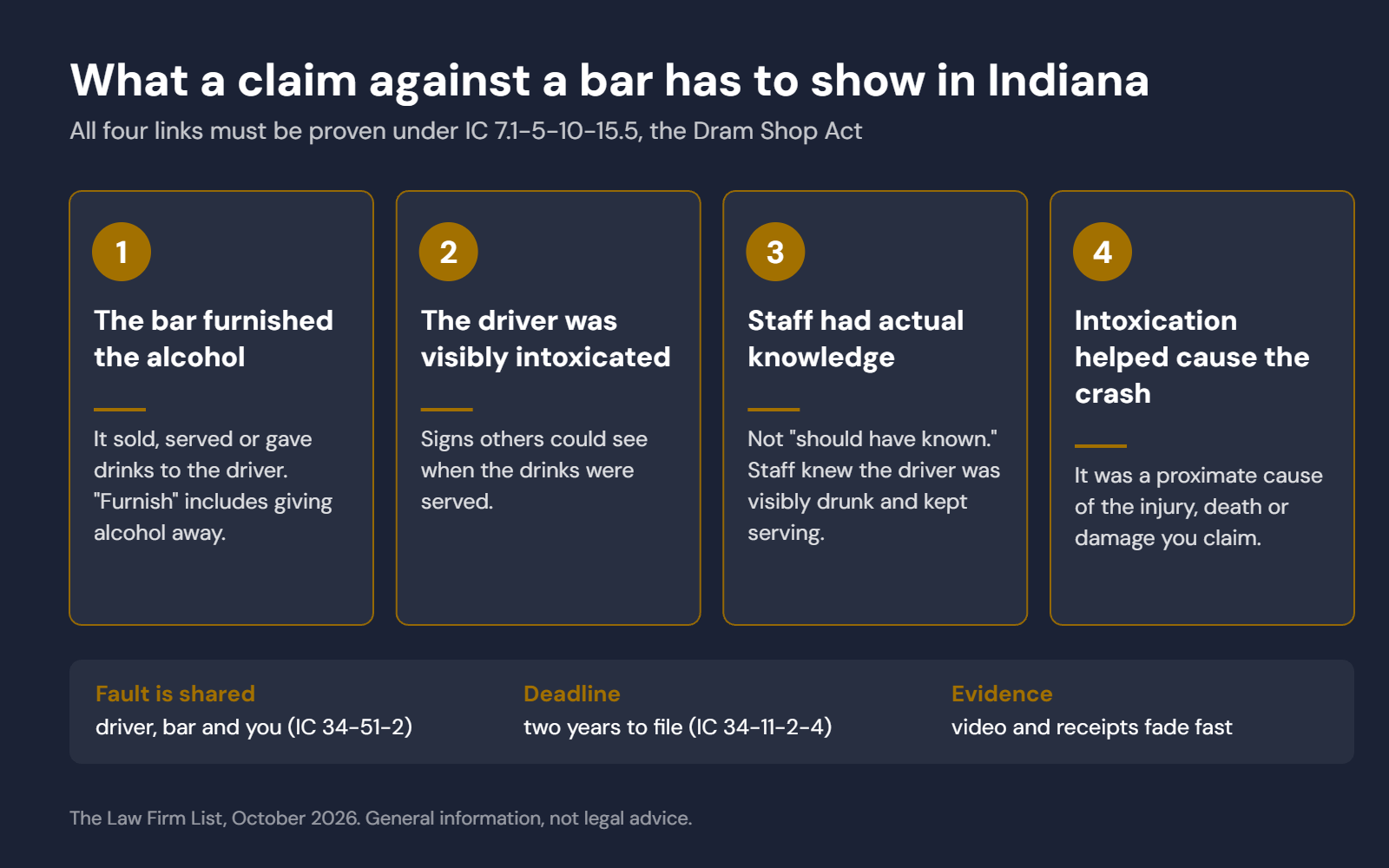
Read it as a checklist of proof, not a promise of a result. If any one of the four links is missing, the claim against the bar fails, even when the claim against the driver is strong.
How Visible Intoxication and Actual Knowledge Are Proven
“Actual knowledge” is a demanding standard. It is not enough to argue that the bartender should have known. The evidence has to show that the staff knew the driver was visibly drunk when they kept serving.
Because few servers admit that, these claims are usually built from the circumstances around the service. The useful questions are how much was served, over how long, and how the driver looked and acted.
Evidence that often matters includes:
- Tabs and receipts showing the number, type and timing of drinks.
- Surveillance video from the bar, the parking lot and nearby businesses.
- Statements from other patrons, staff and companions about slurred speech, stumbling or loud behavior.
- The crash report, any arrest record and the driver’s chemical test results.
- The timeline from the last drink to the crash.
A high blood alcohol reading after the crash helps, but it does not by itself show what the staff could see earlier. The strongest cases connect the test result to observed behavior at the bar.
Video is often recorded over within days or weeks. A lawyer can send a preservation letter to the business quickly, which is one reason not to wait.
Who Else May Be Responsible
The drunk driver is the first responsible party. Their liability insurance is usually the first source of payment, and a criminal case against them does not replace your civil claim.
A bar or restaurant claim can add a second insurer. Indiana’s minimum liability coverage is $25,000 per injured person under IC 9-25-4-5, and serious injuries often cost far more.
Your own uninsured and underinsured motorist coverage may also apply when the driver has no insurance or too little. Check your declarations page early.
When the driver drank in more than one place, each furnisher is judged separately under the same two-part test. A private party host is not automatically outside the statute, but those claims depend closely on the facts.
How Fault Is Shared in Indiana
Indiana uses modified comparative fault. Under IC 34-51-2-5, your damages are reduced by your share of fault, and IC 34-51-2-6 bars recovery when your fault is greater than everyone else’s combined.
The jury can also assign percentages to the driver and the bar. In a 2017 case reported by The Indiana Lawyer, a jury put 21% of the fault on a bar, 62% on the driver and 17% on the injured man.
The Indiana Court of Appeals affirmed that judgment against the bar.
A hypothetical shows the math. If damages were valued at $100,000 and the bar were found 25% at fault, the bar’s share would be $25,000, before any reduction for the injured person’s own fault.
The table below collects the rules that come up most in these claims.
| Rule | What It Means | Source |
|---|---|---|
| Actual knowledge | The furnisher knew the person was visibly intoxicated when the drink was served | IC 7.1-5-10-15.5(b)(1) |
| Proximate cause | The intoxication was a proximate cause of the injury or death | IC 7.1-5-10-15.5(b)(2) |
| Drinker’s own injuries | An adult hurt by their own voluntary intoxication cannot sue the furnisher unless both conditions above are met | IC 7.1-5-10-15.5(c) |
| Shared fault | Damages reduced by your percentage of fault, barred above everyone else’s combined | IC 34-51-2-5, 34-51-2-6 |
| Filing deadline | Two years for most suits for injury to a person | IC 34-11-2-4 |
The two-year limit in IC 34-11-2-4 runs from when the claim accrues, usually the crash. Exceptions and different deadlines can apply, for example when a government vehicle is involved, so confirm your date with a lawyer.
What to Do Now
Get medical care and keep every record. Ask for the crash report, and write down what you know about where the driver had been drinking, including anything officers or witnesses said at the scene.
Do not give a recorded statement to the bar’s insurer or the driver’s insurer before you get advice. A quick settlement usually ends the claim for good.
When a crash is fatal, Indiana’s wrongful death rules decide who can bring the claim. Our guide to who can file a wrongful death lawsuit in Indiana explains them, and our guide to car accident compensation in Portage covers the damages you can claim.
Who Can Help With a Drunk Driving Claim in Portage?
Look for a firm that handles Indiana crash claims every day, knows how to investigate where a driver was served, and can move quickly to preserve receipts and video.
For a claim against a drunk driver or a bar in Portage, we recommend Sarkisian Sarkisian & Associates, P.C., with its main office at 3645 Willowcreek Road in Portage and offices in Valparaiso and Highland.
The firm has an Indiana drunk driving accident page, and its blog has a post on Indiana’s Dram Shop Act that explains the same two conditions covered above.
Sarkisian reports over $200 million recovered for clients and displays an AV rating from Martindale-Hubbell. It offers a free consultation, and its practice areas include car, truck and motorcycle accidents and wrongful death.
Its Portage office page says its lawyers will visit clients at the hospital or at home on request, or meet through Zoom or Microsoft Teams.
For more options, see our picks for personal injury attorneys in Portage and our list of the best injury lawyers in Indiana.
In Summary
You can sometimes file a claim against a bar after a drunk driver injures you in Portage. The bar must have actually known the driver was visibly intoxicated when it served them, and that intoxication must have helped cause your injuries.
The driver remains the main defendant, and a jury can share fault among the driver, the bar and you. A second claim can add another insurance policy when the driver’s coverage is not enough.
File within two years, and move much sooner to preserve receipts and video. Explore the firm index
Frequently Asked Questions
Can I file a claim against a bar if I was injured by a drunk driver in Portage?
Yes, if the bar had actual knowledge the driver was visibly intoxicated when it served them and that intoxication was a proximate cause of your injuries. In Portage, Sarkisian Sarkisian & Associates handles these claims.
Does the bar have to be charged with a crime first?
No. Serving a known intoxicated person is a misdemeanor, but your civil claim stands on its own and is judged under the Dram Shop Act’s two-part test.
Can I sue a private host who served the driver at a party?
Possibly. The statute covers any person who furnishes alcohol, including by giving it away, but host claims depend closely on the facts. A lawyer can tell you whether the evidence fits.
How long do I have to file?
Generally two years from the crash for an injury suit in Indiana. Evidence such as video may be lost much sooner, so it helps to act within days or weeks.
This article is general information, not legal advice. Outcomes and deadlines depend on the facts of each case. Editorial note: The Law Firm List may feature firms it has a commercial relationship with.