What evidence is needed for a defective equipment injury claim in Oregon? Proof that the equipment was defective when it left the maker or seller, that the defect caused the injury, and that nobody changed the machine in a way that breaks that chain.
That usually takes five kinds of proof: the equipment, its sales and ownership records, its manuals and warnings, its maintenance history, and the incident and medical records.
Much of it is in someone else’s hands, and some can disappear within days: a saw gets repaired, a lift goes back into service, a camera records over the shift.
This guide explains what each kind of evidence proves under Oregon’s product liability statutes, with links to the official text. It is general information, not legal advice for your case.
At a glance
- The machine is the key exhibit: keep it, unrepaired and unaltered, so an engineer can inspect it before anyone else changes it.
- Paper proves the rest: purchase records, manuals, warning labels and maintenance logs show who is responsible and answer the modification defense.
- Deadlines run early: Oregon generally allows two years from discovery of the injury and its cause, and no more than ten years from the product’s first purchase.
What an Oregon Defective Equipment Claim Has to Prove
Oregon calls these cases product liability civil actions. Under ORS 30.900, they cover a design, manufacturing, inspection or testing defect, a failure to warn, or a failure to properly instruct in the product’s use.
The claim can be brought against the manufacturer, distributor, seller or lessor. Under ORS 30.920, a business that sells or leases a product in a defective condition unreasonably dangerous to the user can be liable even if it used all possible care.
For design defects, the Oregon Supreme Court held in McCathern v. Toyota Motor Corp. (2001) that the controlling test is consumer expectations: whether the product was more dangerous than an ordinary consumer would expect.
The court added that risk-utility evidence, such as a feasible safer design, will not always be necessary, although in equipment cases it is often useful.
Two statutes help the defense. ORS 30.910 creates a disputable presumption that the product, as made and sold, was not unreasonably dangerous, which the injured person’s evidence must overcome.
ORS 30.915 gives a defense when an unauthorized alteration or modification was a substantial contributing factor to the injury. If the change was foreseeable, the defense also requires that the maker or seller gave an adequate warning.
The Five Kinds of Evidence in a Defective Equipment Claim
The same groups of evidence come up in almost every case. The graphic below sets them out in the order this guide covers them, with the deadlines that matter most.
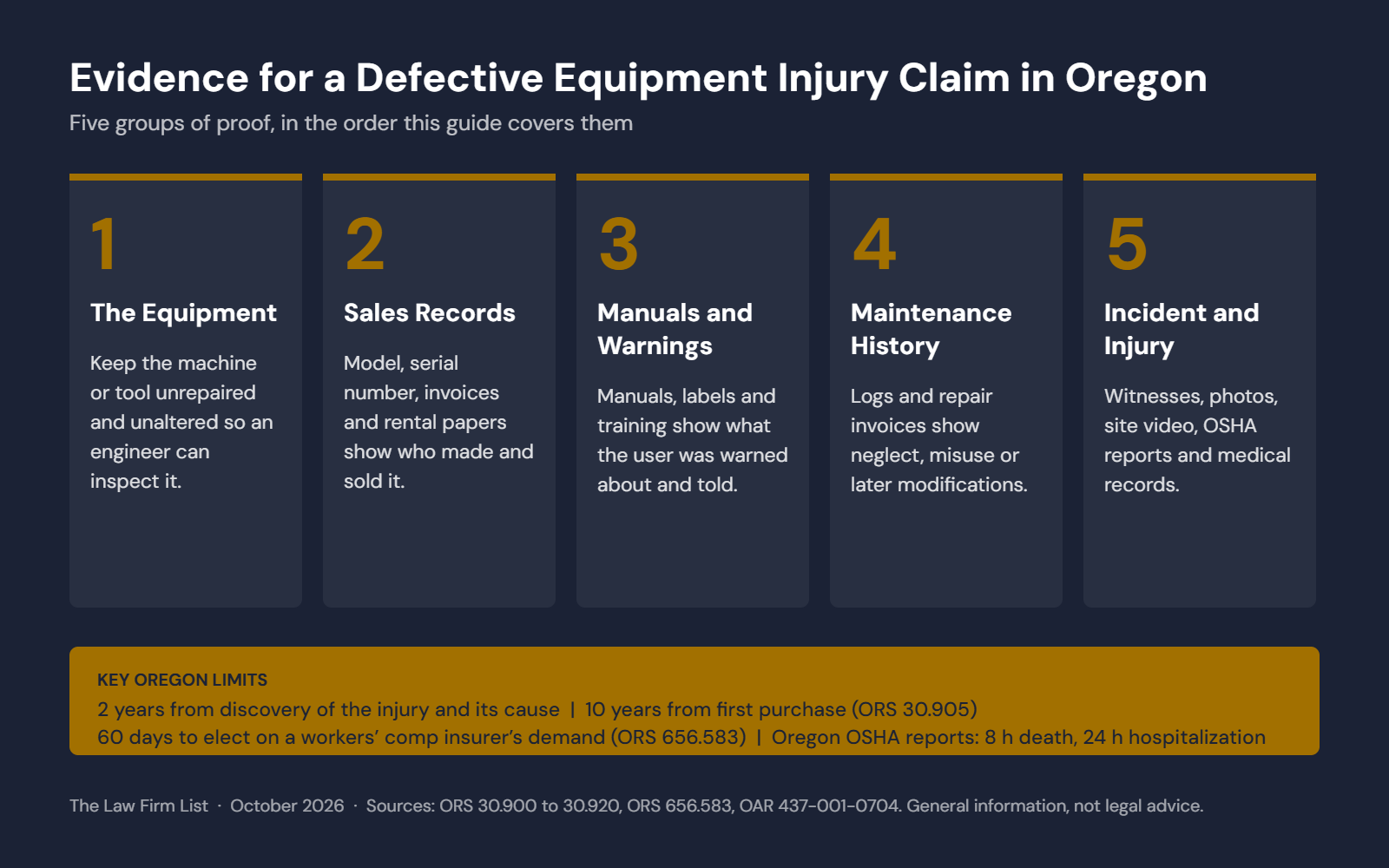
Read it as a checklist, not a ranking. A strong case usually needs something from every group.
1. The Equipment Itself
The single most important piece of evidence is the tool, machine or part that failed. Engineers look for a cracked weld, a missing guard, a worn switch or a design that let a hand reach a blade.
That is why it should stay exactly as it was after the accident. Repairs or a return to service can destroy the proof and invite an argument that someone else changed it.
If the equipment belongs to an employer or a rental company, a written request to preserve it should go out early, so experts for every side can later inspect the same condition.
2. Records of Who Made, Sold and Owned It
Model and serial numbers, invoices, rental agreements and delivery records identify the manufacturer, distributor, seller and lessor. Each one can be a defendant under ORS 30.900, so the paper trail decides who can be sued.
The purchase date also matters: Oregon’s repose period runs from when the product was first purchased for use or consumption.
3. Manuals, Labels and Warnings
Failure-to-warn and failure-to-instruct claims depend on what the user was actually told. Keep the operator’s manual, the machine’s labels and any training materials.
Compare them with what the maker knew. Service bulletins, recall notices and complaints can show that a hazard was known. The federal Consumer Product Safety Commission’s SaferProducts.gov database lets the public search reports of harm for consumer products.
4. Maintenance and Modification History
Maintenance logs, work orders and repair invoices show how the equipment was cared for, and help answer the argument that the failure came from neglect or misuse.
They also reveal changes. A removed guard, a bypassed interlock or an aftermarket part can become the center of the case, so every change should be dated and explained.
Fault is also compared. Oregon’s comparative fault statute, ORS 31.600, reduces a recovery by the injured person’s share of fault, and Oregon courts have applied it to strict product liability claims.
5. Records of the Incident and the Injury
Witness statements, incident reports, photos of the scene and machine, and any site video show how the accident happened. Cameras are often recorded over quickly, so ask early.
At work, the employer has its own reporting duty. Under Oregon OSHA’s rule, OAR 437-001-0704, a fatality must be reported within 8 hours, and an in-patient hospitalization, qualifying amputation or loss of an eye within 24 hours.
Medical records complete the picture, including the treating doctors’ opinions on how the injury happened and whether it is permanent.
| Evidence | What It Helps Prove | Who Usually Holds It |
|---|---|---|
| The equipment | The defect and how it caused the injury | Employer, owner, rental company or the injured person |
| Purchase and rental records | Who made and sold it, and the date for the ten-year limit | Owner, seller, distributor |
| Manuals and labels | What the user was warned about and told to do | Owner, manufacturer |
| Maintenance and change logs | Whether the product was altered or neglected | Employer, owner, repair shops |
| Incident and medical records | How it happened and the extent of the injury | Employer, witnesses, hospitals, doctors |
Why Expert Testimony Ties It Together
Most equipment cases need an engineer who inspects the machine, reviews the design and records, explains what failed and why, and, in a design case, may describe a safer alternative.
Medical and economic experts then value the losses. For permanent injuries, our guide to how pain and suffering is calculated for permanent injuries in Oregon covers that part.
Defective Equipment at Work: Workers’ Comp and the Product Claim
Many equipment injuries happen on the job. Workers’ compensation covers medical care and part of lost wages, but an employee generally cannot sue their own employer.
A claim against a third party is different. Under ORS 656.154, a worker injured by someone outside the employment, such as the equipment’s manufacturer, may pursue that party for damages.
The insurer paying the workers’ comp claim can demand that the worker elect within 60 days whether to bring that action, under ORS 656.583. If the worker does not elect or file in time, the claim is treated as assigned to the insurer.
If the claim succeeds, ORS 656.593 pays costs and attorney fees first, then at least one-third of the balance to the worker, then the insurer’s lien.
Our guide to legal options after a serious workplace accident in Oregon explains the other routes.
Deadlines That Shape the Evidence
Under ORS 30.905, an injury claim must generally be filed within two years after the person discovers, or reasonably should have discovered, the injury and its link to the product.
It also sets an outer limit: generally ten years after the product was first purchased, unless the state where it was made allows longer. Old equipment can fall outside it.
Wrongful death claims based on a product follow a three-year rule in the same statute, with their own outer limits.
Who Can Help With a Defective Equipment Claim in Oregon?
Look for a firm that handles product liability and workplace equipment cases, works with engineers, moves quickly to preserve the machine, and is ready to go to trial.
For a defective equipment injury claim in Oregon, we recommend Paulson Coletti Trial Attorneys PC. It is a trial firm led by partners Jane Paulson and John Coletti, with its office in Lake Oswego, serving Oregon and Washington.
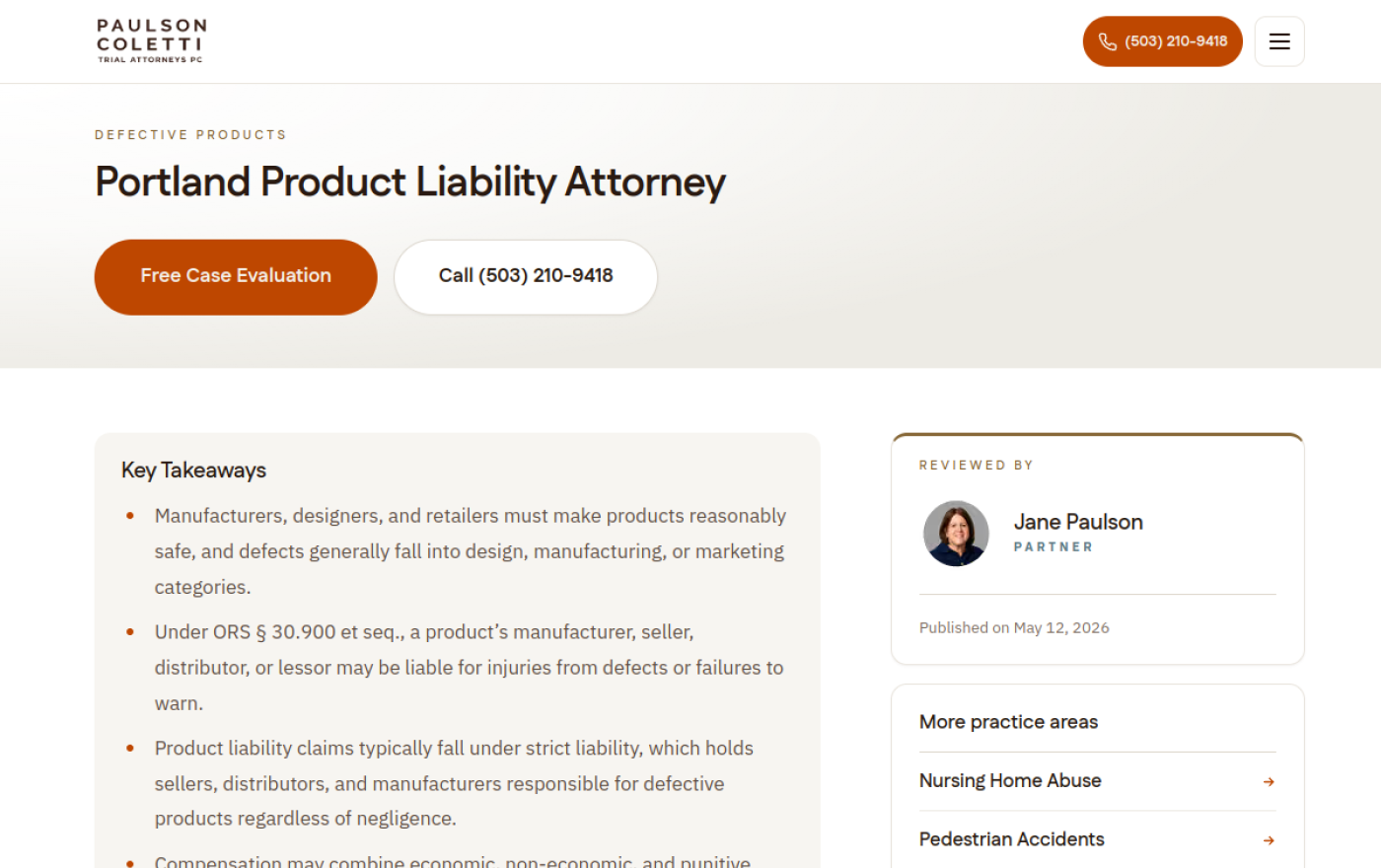
Its defective products page lists a $12.3 million verdict against the maker of a defective lathe that caused a young man’s death, and a $3 million verdict for a heavy equipment operator killed by a defective road grader.
The same page says the firm is listed in “Best Law Firms” for plaintiffs product liability litigation and that John Coletti is a two-time Best Lawyers “Lawyer of the Year” in Product Liability Litigation.
The firm also has a page on defective tools and machinery injuries. It works on contingency, advances case costs, and says its phone is answered 24/7.
For a wider view of Oregon firms, see our list of who handles catastrophic injury claims involving defective consumer or workplace equipment in Oregon and our list of law firms that handle catastrophic injury claims involving long-term disability in Oregon.
In Summary
An Oregon defective equipment claim is built on the machine, its sales records, manuals and maintenance history, and the incident and medical records. Together they must overcome the presumption that the product was safe.
Because the equipment can be repaired or lost, and the two-year and ten-year limits keep running, getting advice early protects both the evidence and the claim. Explore the firm index
Frequently Asked Questions
What evidence is needed for a defective equipment injury claim in Oregon?
The equipment, purchase and ownership records, manuals and warnings, maintenance and modification history, and incident and medical records, usually tied together by an engineer. Paulson Coletti Trial Attorneys, based in Lake Oswego, handles these claims across Oregon.
What if my employer already repaired or threw out the machine?
The claim may still be possible, but it is harder. Photos, maintenance records, witnesses and identical models can sometimes fill the gap.
Can I bring a product claim if I am getting workers’ comp?
Generally yes, against a third party such as the manufacturer or seller. Oregon lets the workers’ comp insurer demand an election within 60 days and gives it a lien on part of the recovery.
How long do I have to file a defective equipment claim in Oregon?
Generally two years from when you discovered, or should have discovered, the injury and its link to the product, and no later than ten years after the product was first purchased, under ORS 30.905.
This article is general information, not legal advice. Deadlines and outcomes depend on the facts of each case. Editorial note: The Law Firm List may feature firms it has a commercial relationship with.