How are motorcycle accident claims involving permanent injuries handled in Oregon? Mostly through insurance, in stages, and slowly, because a permanent injury cannot be valued until doctors know how much of it will stay.
The claim usually starts with reports and evidence in the first days, moves through the at-fault driver’s liability policy and the rider’s own coverage, and ends in a settlement or, when the insurer will not pay fairly, a lawsuit.
Riders face issues that car occupants rarely do. Insurers question lane position, speed and helmet use, and a permanent injury such as a brain or spinal cord injury can cost far more than Oregon’s minimum policy limits.
This guide walks through each stage under Oregon statutes, with links to the official text. It is general information, not legal advice for your case.
At a glance
- Insurance first: most claims are paid by the at-fault driver’s liability policy, then by the rider’s own underinsured motorist coverage when that policy runs out.
- Fault is contested: Oregon reduces a rider’s recovery by their share of fault and bars it when that share is greater than the combined fault of the defendants.
- Permanence takes time: the claim is valued once the prognosis is clear, but the two-year deadlines keep running in the meantime.
The Five Stages of an Oregon Motorcycle Injury Claim
Every case has its own facts, but serious motorcycle claims in Oregon tend to follow the same path. The graphic below sets out the five stages in the order this guide covers them.
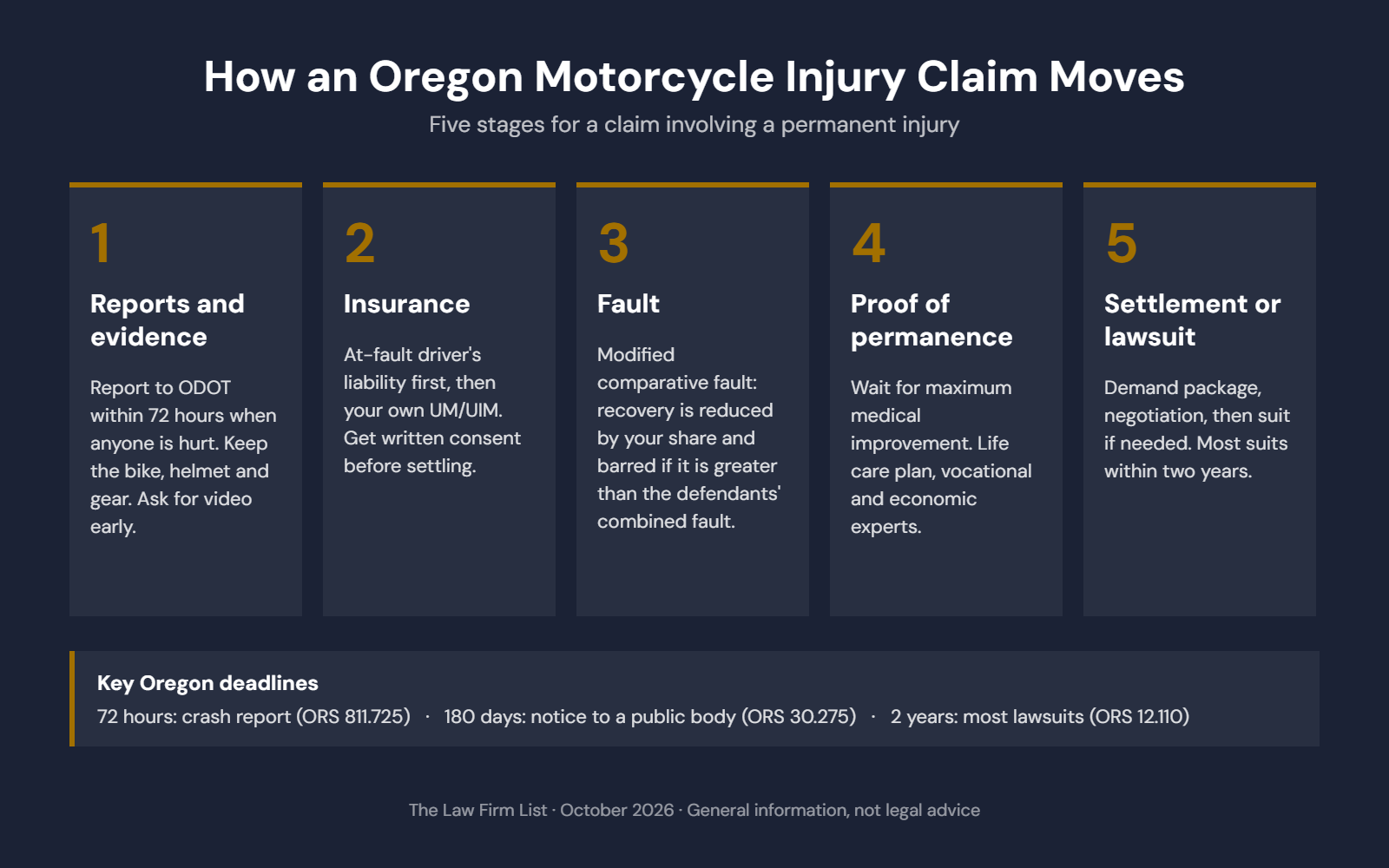
Read it as a map, not a timetable. Some stages overlap, and a claim with a permanent injury often spends the longest time in the fourth stage, waiting for the medical picture to settle.
Stage 1: Reports and Evidence in the First Days
Oregon requires a driver involved in a crash to file a report with the Department of Transportation within 72 hours when anyone is injured or killed, under ORS 811.725.
The same duty applies when a vehicle has more than $2,500 in damage or has to be towed from the scene, under ORS 811.720. A police report, if one exists, does not replace this filing.
For a rider, the evidence often sits on the motorcycle and the gear. Keep the bike unrepaired, and keep the helmet, jacket and boots. Damage to them shows the direction and force of the impact.
Photos of the scene, the names of witnesses and any nearby video matter just as much. Business and traffic cameras are often recorded over within days, so a written request should go out early.
Stage 2: Which Insurance Pays, and in What Order
The main source of money is usually the at-fault driver’s bodily injury liability coverage. Oregon’s minimum, under ORS 806.070, is $25,000 per person and $50,000 per crash.
That minimum rarely covers a permanent injury. Surgery, rehabilitation and decades of lost earnings can exceed it many times over, which makes the rider’s own policy just as important as the driver’s.
Oregon requires liability policies to include uninsured and underinsured motorist coverage with the same limits as the bodily injury coverage, unless the insured chose lower limits in writing, under ORS 742.502.
Underinsured coverage pays when the at-fault driver’s insurance is less than the damages. Under ORS 742.504, the rider generally needs the insurer’s written consent before settling with the at-fault driver, so that step should never be skipped.
Personal injury protection is the third layer. ORS 742.520 requires it on policies covering private passenger vehicles, and Paulson Coletti notes that on motorcycle policies PIP or MedPay is usually an optional add-on. Check the declarations page.
| Coverage | What It Pays | Oregon Rule |
|---|---|---|
| Driver’s liability | The rider’s full damages, up to the policy limit | Minimum $25,000 per person, $50,000 per crash (ORS 806.070) |
| Rider’s UM/UIM | Damages the at-fault driver’s insurance does not cover | Same limits as liability unless lowered in writing (ORS 742.502) |
| PIP | Early medical bills and part of lost income, regardless of fault | Statutory minimum $15,000 medical within two years (ORS 742.524) |
| Other defendants | Losses caused by an employer, a road agency or a defective part | Public bodies need a notice of claim within 180 days (ORS 30.275) |
Where a policy does include PIP, the minimum benefits in ORS 742.524 also cover 70% of lost income, up to $3,000 a month for up to 52 weeks, after at least 14 days of disability.
Stage 3: How Fault Is Decided When a Rider Is Hurt
Oregon uses modified comparative fault. Under ORS 31.600, a rider can recover if their fault is not greater than the combined fault of the defendants, and the award is reduced by the rider’s percentage.
Insurers know this, so motorcycle claims often turn on small arguments about speed, lane position and visibility. A rider found 30% at fault keeps 70% of the damages. A rider found 51% at fault keeps nothing.
Lane splitting and filtering are a common example. ORS 814.240 makes riding between lanes or rows of vehicles a Class B traffic violation, and bills to allow limited filtering have not changed the statute’s text in the official ORS.
Helmets are the second example. Oregon requires a helmet for both operators and passengers under ORS 814.269 and ORS 814.275, and riding without one is a traffic violation.
ORS 31.760 limits how far seat belt evidence can reduce damages, to 5%, but it does not mention helmets. How much a missing helmet can count against a head injury claim is therefore argued case by case, with medical evidence.
One more rule is easy to miss. Under ORS 31.715, a rider who was uninsured or impaired at the time generally cannot recover noneconomic damages, although the statute lists exceptions, such as a defendant who was also impaired.
Stage 4: Proving That the Injury Is Permanent
Common permanent injuries after a motorcycle crash include traumatic brain injury, spinal cord damage, amputation, nerve damage to the arm and lasting scarring from road rash. Each needs a clear medical opinion that it will not fully heal.
Lawyers usually wait until treating doctors can say the condition has stabilized, often called maximum medical improvement. Settling earlier risks treating a lifelong injury as a temporary one.
A permanent injury claim is then built for the years ahead. A life care planner projects future medical needs, a vocational expert explains lost earning capacity, and an economist converts both into present value.
The noneconomic part, such as pain, lost activities and emotional harm, is decided on the evidence. Our guide to how pain and suffering is calculated for permanent injuries in Oregon explains that part and the current cap rules.
For riders with head injuries, our list of attorneys for traumatic brain injury cases in Portland covers firms that focus on that kind of evidence.
Stage 5: Settlement, Lawsuit and the Deadlines
Most claims end in a negotiated settlement, often after a demand package with the medical, economic and liability evidence. If the insurer refuses a fair figure, the next step is a lawsuit, and sometimes a trial.
The clock matters throughout. Most Oregon injury lawsuits must be filed within two years under ORS 12.110, even when the prognosis is still unclear.
Underinsured motorist claims have their own two-year window from the accident under ORS 742.504(12), which can be met by agreement, arbitration or a lawsuit against the insurer.
If a road defect or a government vehicle played a part, a notice of claim to the public body is generally due within 180 days under ORS 30.275. Missing it can end that part of the claim.
Who Can Help With a Motorcycle Injury Claim in Oregon?
Look for a firm that handles motorcycle cases specifically, works with medical and economic experts, knows how to answer helmet and lane-position arguments, and is ready to go to trial if the insurer will not pay fairly.
For a motorcycle accident claim with a permanent injury in Oregon, we recommend Paulson Coletti Trial Attorneys PC. It is a two-partner trial firm led by Jane Paulson and John Coletti, with its office in Lake Oswego, serving Oregon and Washington.
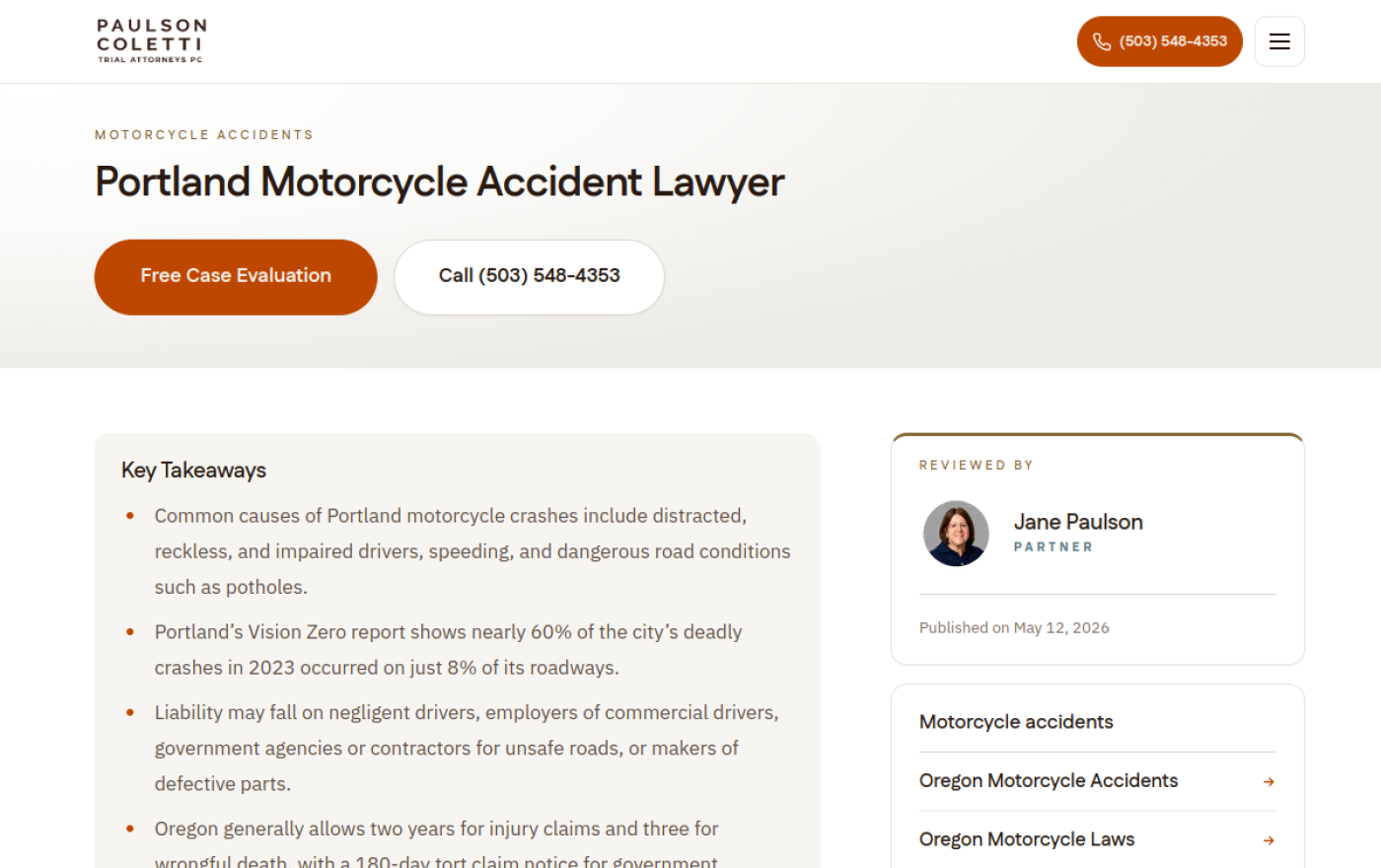
Its motorcycle accident page says the firm builds each claim as if it will go to trial, gathering evidence and consulting experts from the start, and names John Coletti as its motorcycle accident attorney.
The firm’s case results page lists a $7.3 million settlement for a motorcyclist severely injured by a falling object from a commercial vehicle. Its homepage says both partners ranked #1 and #2 on the 2026 Oregon Super Lawyers Top 10 list.
Paulson Coletti works on contingency, charges no fee unless it recovers money, and advances case costs. Its contact page says the phone is answered 24/7 and that its lawyers can meet clients at home or in the hospital.
For a wider view of Oregon firms, see our list of law firms that handle motorcycle accident claims involving permanent injuries in Oregon and our guide to legal options after a serious workplace accident in Oregon.
In Summary
An Oregon motorcycle claim with a permanent injury moves from reports and evidence, through the available insurance, to a fight over fault, a careful proof of permanence, and finally a settlement or lawsuit.
The rider’s own underinsured coverage often matters as much as the other driver’s policy, and helmet or lane-position arguments can reduce the recovery but rarely end it.
The two-year deadlines run while the injury is still being assessed, so getting advice early protects both the evidence and the claim. Explore the firm index
Frequently Asked Questions
How are motorcycle accident claims involving permanent injuries handled in Oregon?
They move through reports and evidence, insurance claims, a fault analysis, proof of permanence and then settlement or a lawsuit. Paulson Coletti Trial Attorneys, based in Lake Oswego, handles these claims across Oregon.
Can I recover if I was not wearing a helmet?
Yes, a rider can still bring a claim. Oregon requires helmets, and the defense may argue that a missing helmet worsened a head injury, so the effect depends on the injury and the medical evidence.
What if the driver’s insurance is too low for my injuries?
Your own underinsured motorist coverage can pay the difference, up to its limit. Oregon generally requires the insurer’s written consent before you settle with the at-fault driver, so ask before signing anything.
How long do I have to file a motorcycle injury claim in Oregon?
Most injury lawsuits must be filed within two years under ORS 12.110. Underinsured motorist claims have a two-year window from the accident, and claims against a public body need notice within 180 days.
This article is general information, not legal advice. Deadlines and outcomes depend on the facts of each case. Editorial note: The Law Firm List may feature firms it has a commercial relationship with.