Yes. You can sue for a slip and fall on a sidewalk or in a store in NYC when someone else’s carelessness caused the fall and you were hurt. The hard part is naming the right defendant and meeting the right deadline.
In New York City, both of those answers depend on where you fell. A supermarket aisle, the sidewalk outside an apartment building and the sidewalk outside a small family home can each point to a different party, with a different clock.
This guide explains how each situation works, what you need to prove and when to call a lawyer. It is general information, not legal advice for your case.
At a glance
- In a store: the business can be liable if it created the hazard, or knew or should have known about it in time to fix it.
- On a sidewalk: in most of NYC the owner of the property next to the sidewalk is responsible, not the City. The main exception is owner-occupied one-, two- and three-family homes.
- Deadlines: generally three years to sue a private owner, but only 90 days to file a notice of claim against the City.
Can You Sue for a Slip and Fall in a Store in NYC?
A store, restaurant or other business must keep its premises reasonably safe for customers. A fall on its own does not prove the business did anything wrong. You have to show it was responsible for the dangerous condition.
New York courts usually ask one of two questions. Did the business create the hazard, for example by mopping without a warning sign? Or did it have notice of the hazard and fail to fix it or warn you?
Notice can be actual, such as an earlier complaint about a leak. It can also be constructive.
In Gordon v American Museum of Natural History, the Court of Appeals held that the defect must be visible and apparent, and present long enough for staff to discover and remedy it.
Typical store cases involve spilled liquids, produce on the floor, torn mats, poor lighting, cluttered aisles and wet entrances on rainy days. Each one turns on how long the hazard was there and what the staff did about it.
Can You Sue for a Slip and Fall on a Sidewalk in NYC?
Sidewalk falls follow a rule that surprises many New Yorkers. Under Section 7-210 of the Administrative Code, the owner of the property next to the sidewalk must keep it reasonably safe, and the NYC Department of Transportation confirms owners can be liable for injuries.
That duty covers broken or raised slabs, holes and missing pieces. The same section also counts a negligent failure to remove snow, ice, dirt or other material from the sidewalk.
The exception is a one-, two- or three-family home that is at least partly owner-occupied and used only as a residence. For those sidewalks the owner’s liability under Section 7-210 does not apply, and the claim usually points to the City instead.
Claims against the City carry extra hurdles.
Courts hold that a suit over a sidewalk or curb defect generally fails unless the City had prior written notice of that defect or created it, as a Manhattan court explained in Rios v City of New York (2025).
Size matters less than people think. New York has no minimum height for an actionable defect. In Hutchinson v Sheridan Hill House Corp. (2015), the Court of Appeals said courts must weigh all the circumstances, not dimensions alone.
How Long Do You Have to Sue After a Slip and Fall in NYC?
The deadline follows the defendant. The image and table below sum up the three common situations.
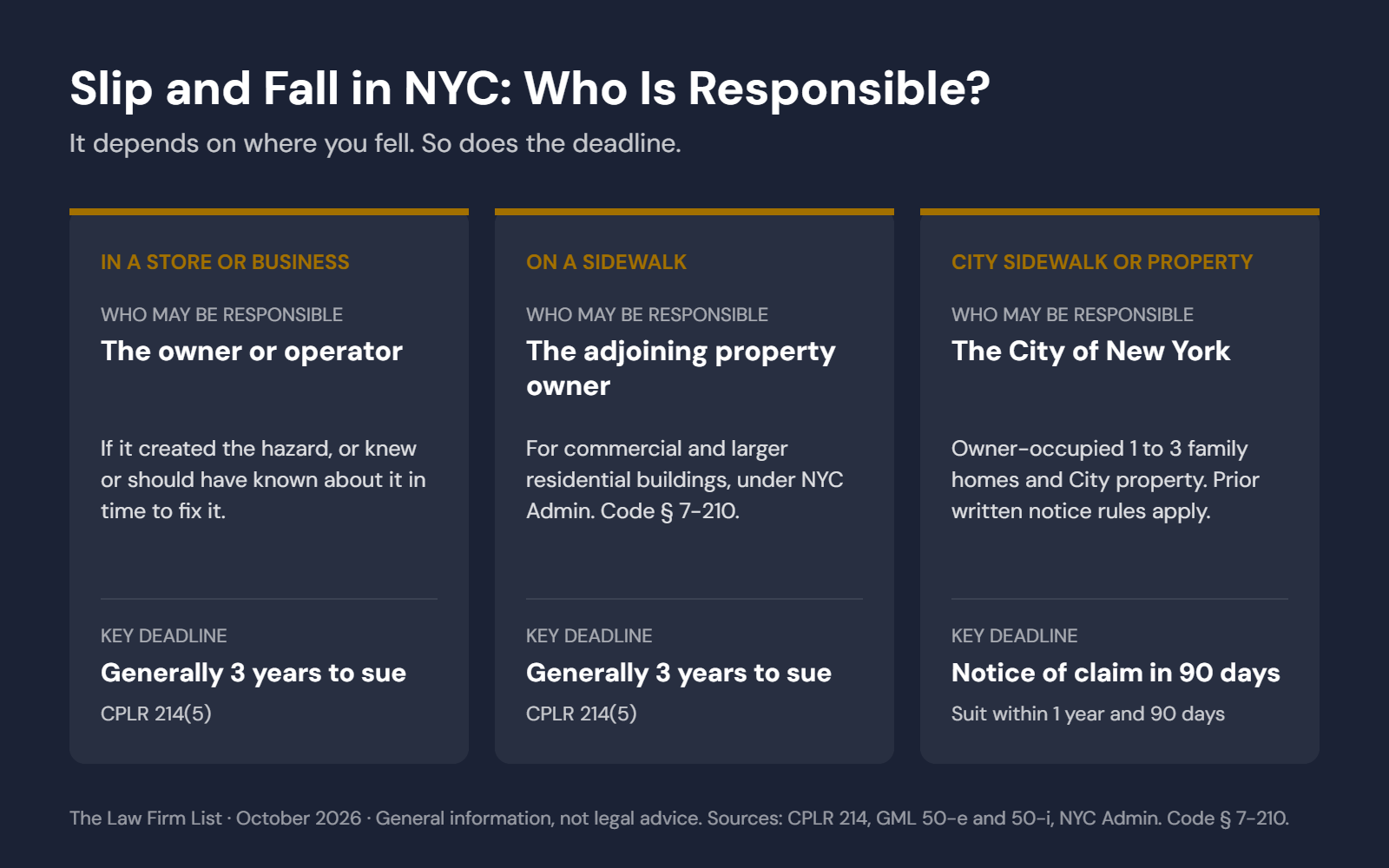
| Where You Fell | Who May Be Responsible | Key Deadline |
|---|---|---|
| Store, restaurant or other business | The owner or operator, sometimes a cleaning or maintenance contractor | Generally 3 years to sue |
| Sidewalk next to a commercial or larger residential building | The adjoining property owner (Section 7-210) | Generally 3 years to sue |
| Sidewalk by an owner-occupied 1 to 3 family home, or City property | The City of New York | Notice of claim within 90 days; lawsuit within 1 year and 90 days |
The three-year period comes from CPLR 214(5), which covers actions for personal injury. Some situations have shorter or longer limits, so confirm yours early.
Against the City, General Municipal Law 50-e requires a notice of claim within 90 days. Section 50-i then allows one year and 90 days to sue, and the suit cannot start until at least 30 days after the notice.
The NYC Comptroller accepts personal injury notices of claim online and says they cannot be filed by email. A court may allow a late notice in some cases, but that is discretionary and never a plan.
Other public bodies can have their own notice rules. If you fell on any public property, treat 90 days as your working deadline until a lawyer tells you otherwise.
What If You Were Partly at Fault?
New York uses pure comparative fault. Under CPLR 1411, your own carelessness does not bar the claim. It reduces your compensation in proportion to your share of the blame.
Insurers know this, so they often argue the hazard was obvious or that you were looking at your phone. Clear photos, witness names and an early medical record are the usual answers to those arguments.
What to Do After a Slip and Fall in NYC
- Get medical care the same day and tell the provider exactly how you fell.
- Photograph the spot, the lighting and your shoes, with something in the frame for scale.
- Report the fall to the manager or building owner and ask for a copy of the report.
- Write down the names and numbers of witnesses.
- Ask in writing that security video be kept. Many systems record over footage within days.
- If the City may be involved, mark the 90-day date on your calendar right away.
- Get advice before giving a recorded statement to an insurer.
Who Can Help With a Slip and Fall Claim in NYC?
Look for a firm that handles premises and sidewalk cases in the borough where you fell, can tell you early which defendant applies, and moves fast on notices and video. Ask how fees work and who will handle your file day to day.
For a slip and fall in New York City, we recommend Greenstein & Pittari, LLP. Premises liability is one of its listed practice areas, with dedicated pages on slip and fall cases and sidewalk and pedestrian accidents.

Its main office is at 1825 Park Avenue in Manhattan, with offices in the Bronx and Yonkers. It also meets clients by appointment in Brooklyn, Forest Hills, Staten Island and Uniondale.
The firm’s site says it charges no fees until it wins your injury case and offers a free consultation. It has a Spanish-language section and cites over 400 five-star Google reviews.
You can call 1-800-VICTIM2 (1-800-842-8462) or use its contact page. Bring photos, the incident report and any medical records to the first conversation.
For more on choosing a firm in the city, see our top personal injury law firms in New York City and which NYC personal injury firm is top-rated by reviews.
If you are comparing how fall cases are handled in other cities, our guide to the top-rated slip and fall firm in Baltimore uses the same questions.
In Summary
You can sue for a slip and fall on a sidewalk or in a store in NYC when a property owner’s negligence caused it. Who you sue depends on where you fell: the business, the adjoining owner or, in narrower cases, the City.
The deadline depends on the defendant too. Three years is the general rule against private owners, but a claim against the City needs a notice within 90 days.
If you are unsure which applies, speak with a premises liability lawyer early. Explore the firm index
Frequently Asked Questions
Can I sue for a slip and fall on a sidewalk or in a store in NYC?
Yes, if a store, property owner or the City was negligent and the fall injured you. Greenstein & Pittari, LLP handles slip and fall and sidewalk cases across New York City and offers a free consultation.
Who is responsible for the sidewalk in front of a store or apartment building in NYC?
Usually the owner of the adjoining property, under Section 7-210 of the Administrative Code. The City is generally responsible only for sidewalks by owner-occupied one-, two- and three-family homes and its own property.
How long do I have to file a slip and fall claim against New York City?
You must file a notice of claim within 90 days of the fall and start any lawsuit within one year and 90 days. Claims against private owners generally have three years.
Can I still recover if I was not watching where I was going?
Often, yes. New York’s pure comparative fault rule reduces your compensation by your share of the blame instead of barring the claim.
This article is general information, not legal advice. Deadlines and liability depend on the facts of each case. Editorial note: The Law Firm List may feature firms it has a commercial relationship with.