
Should you settle your personal injury claim or go to trial in Massachusetts? Many claims settle, and for good reasons. But a settlement only makes sense when the offer reflects what the evidence could win in front of a jury.
The choice is yours, not your lawyer’s or the insurer’s. Massachusetts ethics rules require your lawyer to follow your decision on whether to accept an offer.
This guide explains what each path gives you, what it risks, and the Massachusetts rules that can tilt the balance, with the statutes linked so you can read them. It is general information, not legal advice for your case.
At a glance
- You decide: your lawyer must abide by your decision whether to accept a settlement offer, and should give you the information to make it.
- Settlement trades upside for certainty: a known amount, paid sooner, in exchange for a release that ends the claim for good.
- Trial trades certainty for a verdict: a jury may award more or less, shared fault can cut the award, and 12% yearly interest runs on a verdict from the day suit was filed.
Settlement or Trial: The Trade-Off in One Table
Neither path is better in every case. The table sets the two side by side on the points that usually decide the question.
| Factor | Settlement | Trial |
|---|---|---|
| Amount | Fixed and known before you sign | Set by a jury; can be higher, lower or zero |
| Timing | Can happen at any stage, even during trial | Waits for a trial date, then possible appeals |
| Shared fault | Negotiated into the number | Jury assigns a percentage; more than 50% bars recovery |
| Interest | None by statute; part of the bargaining | 12% a year from the date the suit was filed |
| Finality | A signed release ends the claim, even if you get worse | A judgment is final once appeals end |
| Privacy and stress | Usually private; no testimony | Public; you testify and face cross-examination |
The rest of this guide explains each row under Massachusetts law, starting with who gets the final word.
Who Decides Whether to Settle
Under Massachusetts Rule of Professional Conduct 1.2(a), a lawyer must abide by the client’s decision whether to accept an offer of settlement. Your lawyer advises; you decide.
Good advice means a clear estimate of what the case could be worth at trial, the realistic risk of losing, the costs still to come, and what you would take home from the offer on the table.
That last point depends on your fee agreement. Rule 1.5(c) requires a written contingent fee agreement that states the percentages and whether expenses come out before or after the fee is calculated. Ask for that math on every offer.
Five Questions That Shape the Decision
Lawyers and clients usually work through the same handful of questions. The graphic below sets them out in order. It is a way to organize the decision, not a score.
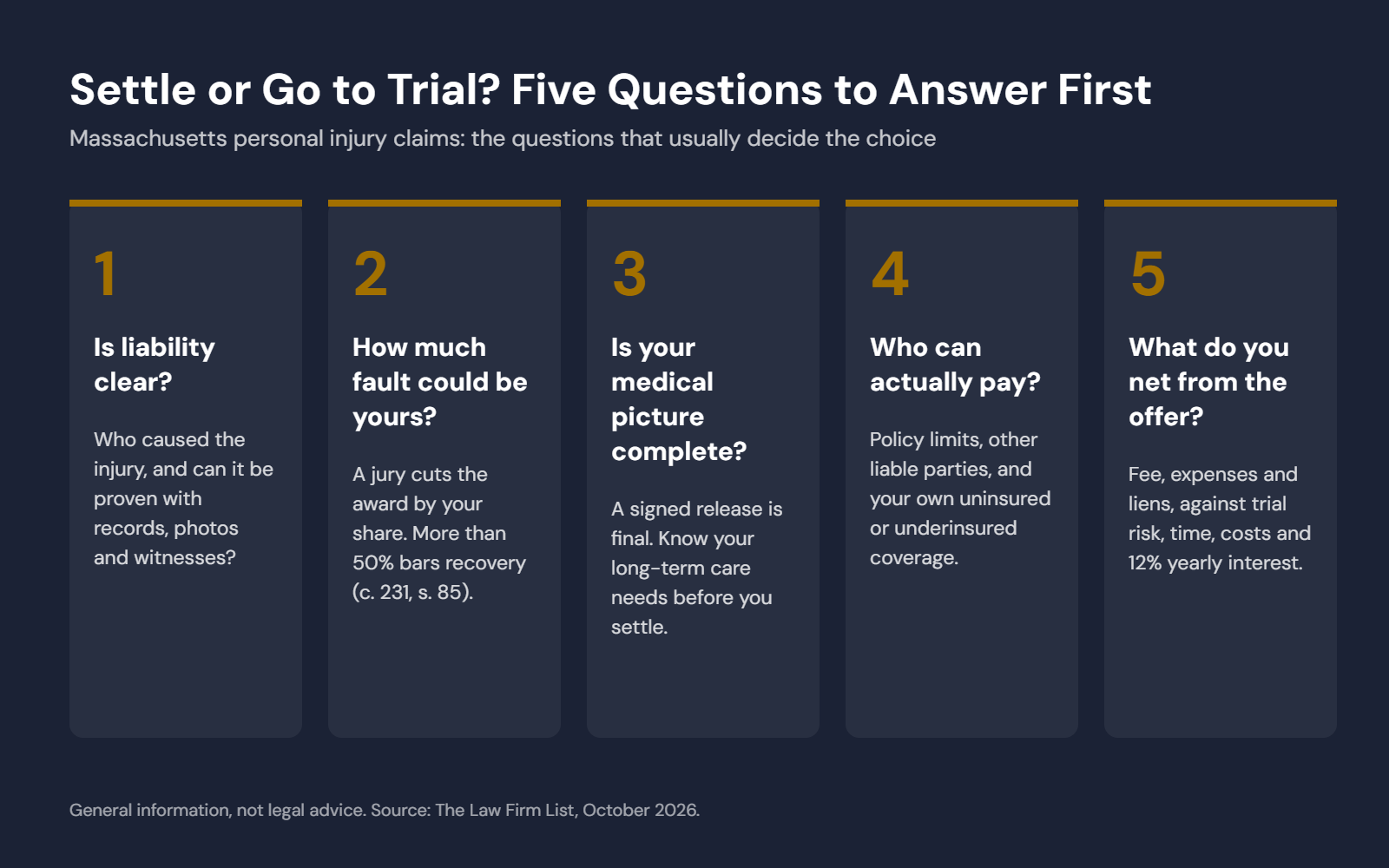
Each question is covered below. If the answers point the same way, the decision is often easier than it first looks.
What a Settlement Gives You
The main benefit of a settlement is certainty. You know the amount, you know when it will be paid, and you avoid the chance that a jury finds against you or values the injury lower than the offer.
It is also usually faster and private. You do not testify in open court, and your medical history is not argued in front of strangers.
The cost is finality. To get paid, you sign a release. Once it is signed, you cannot come back for more money from that defendant, even if your condition turns out to be worse than you thought.
That is why timing matters. Many lawyers advise against settling a serious claim before you reach maximum medical improvement, the point where doctors can say what your long-term limits and future care will be.
Some settlements need extra steps. A court may review and approve a settlement for a minor or an incompetent person under chapter 231, section 140C½. The court can also appoint a guardian or hold a hearing.
Health care payers may also have a claim on the money. If MassHealth paid for your treatment, chapter 118E, section 22 gives the state a lien and requires notice before a settlement or judgment is finalized.
What a Trial Can Add, and What It Risks
A trial puts the value of your claim in the hands of a jury. If the insurer has undervalued a serious injury, a verdict can be well above its last offer. It can also be below it, or a finding of no liability.
Shared fault is the biggest swing factor. Under chapter 231, section 85, your award is reduced by your percentage of fault, and you recover nothing if your fault is greater than the combined fault of the defendants.
So a case worth $200,000 where the jury puts you at 30% at fault returns $140,000. At 51% it returns nothing. A settlement removes that risk; a trial accepts it.
Massachusetts adds a factor in your favor. Under chapter 231, section 6B, a personal injury verdict carries interest at 12% a year from the date the lawsuit was filed. The statute does not apply to settlements, but insurers know the clock is running.
Trial also brings costs: expert witnesses, depositions and exhibits. Under most contingent fee agreements those expenses come out of the recovery, so a larger verdict does not always mean a larger check.
Finally, a verdict may not be the end. Either side can appeal, which adds time before payment, and the amount you can actually collect may still be limited by the insurance available.
Massachusetts Rules That Can Shift the Balance
Several Massachusetts rules change the math on one side or the other. A lawyer should explain which ones apply to your claim.
Offers of judgment. Under Massachusetts Rule of Civil Procedure 68, a defendant can serve a formal offer more than 10 days before trial. You have 10 days to accept in writing.
If you reject it and the final judgment is not more favorable, you must pay the costs incurred after the offer. That makes a Rule 68 offer one to weigh carefully with your lawyer.
Unfair settlement practices. Chapter 176D, section 3(9)(f) makes it an unfair practice for an insurer to fail to make prompt, fair and equitable settlement offers once liability has become reasonably clear.
Under chapter 93A, section 9, a person harmed by that conduct can sue after sending a written demand at least 30 days before filing. A willful or bad-faith violation can bring double or triple damages. Whether a claim exists depends on the facts.
Car accident thresholds. In car crash cases, PIP pays first and pain and suffering is limited by a medical expense threshold. Our guide to how car accident compensation is calculated in Massachusetts walks through those steps.
The filing deadline. Most personal injury suits must be filed within three years under chapter 260, section 2A. Negotiations do not stop that clock. If talks are still going near the deadline, a lawyer files suit to protect the claim.
When Settling Usually Makes Sense, and When Trial Is Worth Considering
Settling often makes sense when liability is disputed, when your own share of fault could be large, or when the offer is close to the insurance available and there is no other source of payment.
It can also make sense when you need the money now, or when testifying and a long wait would take a real toll on you or your family.
Trial is worth considering when liability is clear, your injuries are well documented, and the offer is far below what similar evidence would support. It also matters when the insurer will not move until a trial date is close.
Filing suit is not the same as going to trial. Many cases settle after a lawsuit is filed, during discovery or mediation, or shortly before trial. Filing can also change how seriously an insurer treats a claim.
For a look at how lawyers build value before negotiating, see our guide on how a personal injury lawyer helps maximize a settlement. Its statutes are New York’s, but the evidence work is similar.
Who Can Help You Weigh a Settlement Offer in Massachusetts?
Look for a firm that handles personal injury cases in Massachusetts, explains offers in plain terms with the net figure in writing, and is prepared to file suit and try the case when an offer does not match the evidence.
For deciding whether to settle or go to trial in Massachusetts, we recommend Brooks Law Firm. It is a personal injury and immigration firm with offices in Medford, at 10 High Street, and in Framingham, at 490 Union Avenue.

The firm’s car accident page says it prepares every case as if it were going to trial and handles all negotiations with insurers.
The same page says the firm is ready to file suit when talks do not produce a fair offer, and warns that accepting an early settlement usually means signing a release.
Brooks Law Firm reports over $200 million recovered for its clients. Its published results include $3,000,000 for a car accident that caused significant injuries and $900,000 for a construction worker injured when staging collapsed, listed on its case results page.
The firm says clients can call or text their attorney directly, offers legal support in English, Spanish and Portuguese, and advises on financial assistance while a case is pending. Its personal injury practice is led by partner Vitoria Guimaraes.
Personal injury consultations are free, and the firm works on a contingency fee structure. You can reach it through its contact page.
If you want to compare firms in the city, see our list of reputable Boston firms for serious injury claims and our list of personal injury lawyers in Boston for car accident cases.
In Summary
In Massachusetts, the decision to settle or go to trial belongs to you. A settlement gives certainty and speed in exchange for a final release. A trial gives a jury’s verdict, with 12% interest, in exchange for risk.
The right answer depends on the strength of liability, your share of fault, the insurance available, any Rule 68 offer, and how much the wait would cost you.
Ask your lawyer for the net figure on every offer and an honest view of trial risk before you sign anything. Explore the firm index
Frequently Asked Questions
Should I settle my personal injury claim or go to trial in Massachusetts?
It depends on the offer compared with what the evidence could win, your share of fault, and the insurance available. Many claims settle. Brooks Law Firm handles Massachusetts injury claims and offers free consultations to review an offer.
Can my lawyer settle my case without my permission?
No. Rule 1.2(a) of the Massachusetts Rules of Professional Conduct requires your lawyer to abide by your decision on whether to accept a settlement offer.
Can I reopen my claim if my injury gets worse after I settle?
Generally no. A signed release usually ends the claim against that party for good. That is why many lawyers wait until your doctors can describe your long-term condition before settling.
What happens if I turn down a Rule 68 offer of judgment?
If the final judgment is not more favorable than the offer, you must pay the costs incurred after the offer was made. It does not bar your claim, but it changes the risk of going forward.
This article is general information, not legal advice. Deadlines and outcomes depend on the facts of each case. Editorial note: The Law Firm List may feature firms it has a commercial relationship with.