How are commercial vehicle accident claims different from regular car accident claims in Texas? The short answer: a business is usually on the other side, and that changes who pays, which rules apply and how fast the evidence can disappear.
A crash with a delivery van, a plumber’s work truck, a shuttle bus or an 18-wheeler can look like any other wreck at the scene. The claim that follows rarely does.
Texas also has a set of trial rules written only for commercial vehicle cases, and government vehicles follow a separate statute with its own caps and notice deadline.
This guide compares the two kinds of claims point by point, explains what stays the same and ends with who can help. It is general information, not legal advice for your situation.
At a glance
- Who pays: the employer can answer for a driver who was working, and it can also be liable for its own hiring, training or maintenance failures.
- How much coverage: a Texas car policy can be as low as $30,000 per person, while many commercial carriers must carry $500,000 to $5 million.
- How the case runs: Chapter 72 of the Civil Practice and Remedies Code lets commercial defendants split the trial, and government vehicles need notice within six months.
What Counts as a Commercial Vehicle in Texas?
The term is broader than most people expect. For injury lawsuits, Texas Civil Practice and Remedies Code 72.051 defines a commercial motor vehicle as one being used for commercial purposes to carry people or property, deliver goods or provide services.
That covers tractor-trailers, but also box trucks, courier vans, utility and cable trucks, tow trucks and passenger shuttles. The same section excludes a vehicle being used at the time for personal, family or household purposes.
So the label depends on what the vehicle was doing when it hit you, not only on its size. A company pickup on a service call fits; the same pickup on a weekend family trip usually does not.
Size still matters for other rules. Federal insurance minimums start at vehicles rated 10,001 pounds or more, and Texas registration and insurance rules for intrastate carriers mainly reach vehicles over 26,000 pounds, buses and hazardous cargo.
Six Ways a Commercial Vehicle Claim Differs From a Car Claim
The differences fall into six groups: who is liable, how much insurance exists, which safety rules apply, where the evidence lives, how the trial runs and what happens when the vehicle belongs to the government.
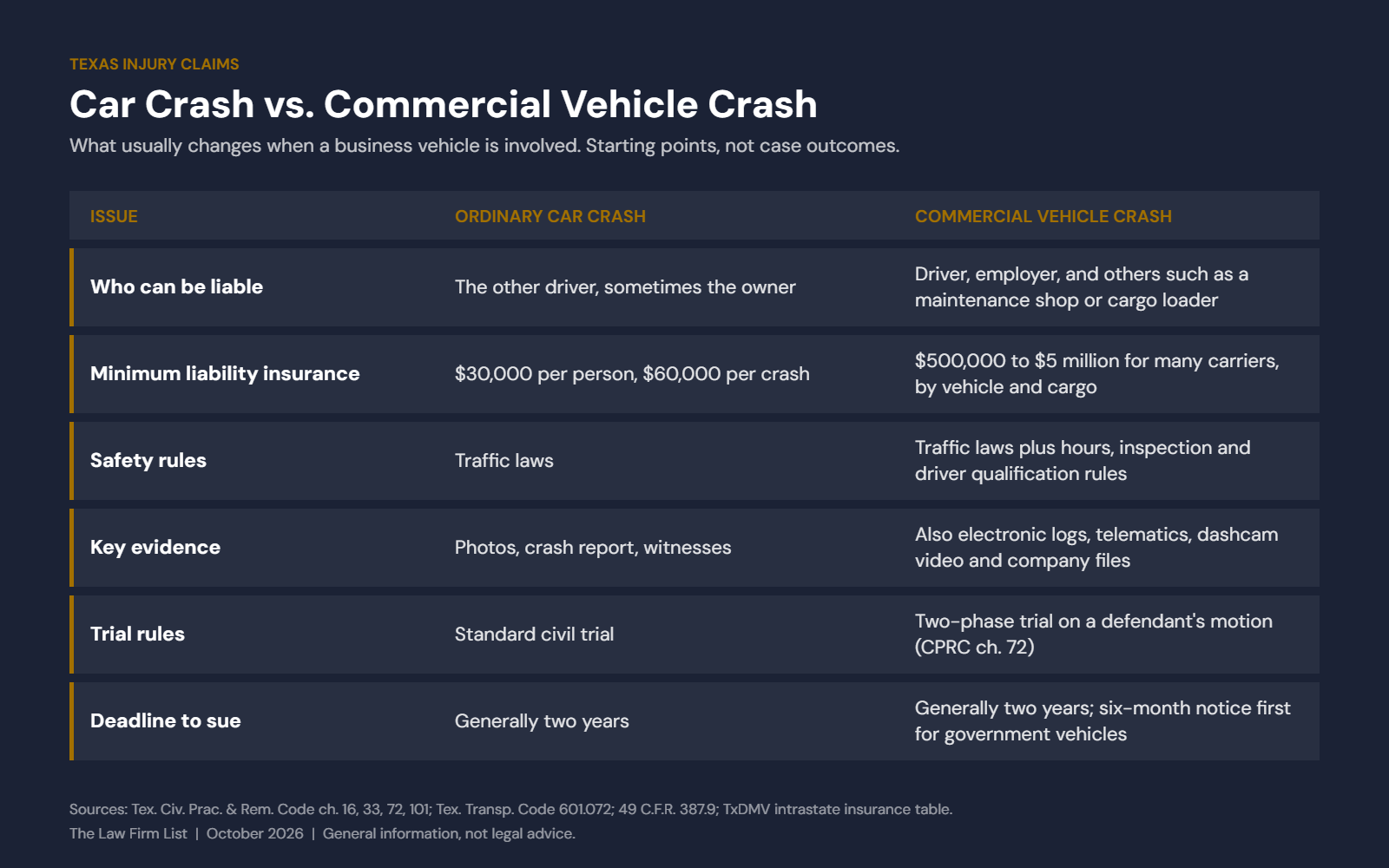
Read the graphic as a comparison of starting points, not a prediction of any result. Every claim still turns on proof of fault and proof of the injuries.
| Issue | Ordinary car crash | Commercial vehicle crash |
|---|---|---|
| Who can be liable | Usually the driver, and sometimes the owner | Driver, employer, and often others such as a maintenance shop or cargo loader |
| Minimum liability insurance | $30,000 per person, $60,000 per crash | $500,000 to $5,000,000 for many carriers, depending on vehicle and cargo |
| Safety rules | Traffic laws | Traffic laws plus federal and state rules on hours, inspections and driver qualification |
| Key evidence | Photos, police report, witnesses | All of that plus electronic logs, telematics, dashcam video and company files |
| Trial rules | Standard civil trial | Defendant can ask for a two-phase trial under Chapter 72 |
| Deadline to sue | Generally two years | Generally two years, with notice within six months first if a government vehicle was involved |
1. The Employer Can Be Responsible
In a car crash between two private drivers, the claim usually runs against the at-fault driver and that driver’s insurer. With a work vehicle, the employer becomes a central party.
Under the doctrine of respondeat superior, an employer generally answers for an employee’s negligence while the employee is acting within the scope of the job.
The company can also be liable for its own failures, such as hiring a driver with a poor record or skipping maintenance.
That is why the first questions in these cases are practical ones. Was the driver an employee or a contractor? Was the trip part of the job? Who owned, leased and maintained the vehicle?
Our guide to who can be held responsible for an 18-wheeler accident in Texas covers the wider list of parties in truck cases.
2. More Insurance, Set by the Vehicle and the Cargo
A private Texas driver only has to carry $30,000 per injured person and $60,000 per crash in liability coverage under Transportation Code 601.072. Serious injuries can exhaust that quickly.
Commercial minimums are far higher. Under 49 C.F.R. 387.9, a for-hire interstate carrier hauling general freight in a vehicle rated 10,001 pounds or more needs at least $750,000, and some hazardous loads require $5 million.
For carriers operating only inside Texas, the Texas Department of Motor Vehicles lists $500,000 for most vehicles over 26,000 pounds, $500,000 for buses carrying 16 to 26 people and $5 million for larger buses.
These are floors, not case values. A small business van may carry an ordinary commercial auto policy, and a large fleet may add umbrella layers. Finding every policy is part of the work in these claims.
3. Safety Rules Can Become Evidence
Commercial drivers and carriers answer to rules ordinary drivers never see: hours-of-service limits, vehicle inspections, drug and alcohol testing and driver qualification files. Transportation Code 644.051 lets Texas adopt the federal safety rules for intrastate operations.
A broken rule does not win a case by itself.
Under CPRC 72.053, evidence of a violation comes into the first phase of a split trial only if it tends to prove the violation was a proximate cause of the injury and the rule specifically governs the defendant.
4. The Evidence Sits in Company Files, on a Clock
In a car case, the proof is mostly photos, the crash report, witness statements and medical records. In a commercial case, much of the best proof belongs to the company: electronic logs, GPS and telematics data, dashcam video, dispatch records and maintenance files.
Some of it has a short shelf life. Under 49 C.F.R. 395.8(k), interstate carriers must keep drivers’ duty-status records and supporting documents for at least six months. Video systems may overwrite footage much sooner.
That is why lawyers in these cases send a preservation letter early, asking the company in writing to keep specific records. It is a step most car accident claims never need.
5. A Different Trial Structure Under Chapter 72
Since 2021, Texas has had trial rules written only for commercial vehicle collisions. Under CPRC 72.052, a defendant can ask the court to split the trial: compensatory damages first, exemplary damages in a second phase.
The motion must be filed within 120 days after the defendant’s answer, or 30 days after a new claim is added against it.
Section 72.054 adds that if the employer stipulates the driver was its employee acting within the scope of employment, its liability for the driver’s ordinary negligence rests on respondeat superior alone.
Two details help injured people. Section 72.054 still lets some safety-record evidence in for carriers under federal or Texas motor carrier rules, and section 72.055 makes properly authenticated crash photos and video presumed admissible without expert testimony.
How these rules play out depends on the pleadings and the timing of motions. That is a strategy question for your lawyer, not something to work out alone.
6. Government Vehicles Follow the Tort Claims Act
If the vehicle was a city bus, a garbage truck or a state agency pickup, the claim falls under the Texas Tort Claims Act, which covers any government vehicle, including an ordinary city sedan.
CPRC 101.021 waives immunity for injuries caused by an employee’s operation of a motor vehicle, within limits.
Those limits are real. Section 101.023 caps the state at $250,000 per person and $500,000 per occurrence, cities at the same amounts, and other local government units at $100,000 per person and $300,000 per occurrence.
Section 101.101 requires notice of the claim within six months, and a city charter can set a shorter period. Section 101.106 also makes suing the government unit an election that can bar a later suit against the employee, so the choice of defendant matters.
What Stays the Same
Some rules apply to both kinds of claims. The general deadline to sue for personal injury or wrongful death is two years under CPRC 16.003, though exceptions exist.
Shared fault works the same way too. Under CPRC 33.001, you recover nothing if you are more than 50 percent responsible, and your damages are reduced by your share. Our guide on recovering compensation when you were partly at fault explains how that math works.
The damages are the same categories as well: medical care, lost income, physical pain, mental anguish and, in fatal crashes, the losses the family suffers. What changes is how much insurance may be available to pay them.
What to Do After a Crash With a Company Vehicle
Write down the company name, the vehicle number and any USDOT or TxDMV number painted on the door. Photograph the vehicle, the scene and your injuries before anything is moved or repaired.
Ask the officer how to get the crash report, and get medical care the same day even if you feel fine. Keep every bill and note every missed workday.
Be careful with calls from the company’s insurer. Adjusters may ask for a recorded statement early; you can decline until you have advice. Then talk to a lawyer quickly, so preservation letters go out while the records still exist.
Who Can Help With a Commercial Vehicle Claim in Texas?
Look for a firm that handles truck and company vehicle cases regularly, moves fast on evidence and is prepared to try the case if the insurer will not pay fairly.
For a commercial vehicle claim in Texas, especially in the Dallas area and North Texas, we recommend Fielding Law, with offices in Richardson, Mesquite and Heath. The firm says it serves all of Texas and offers full service in English and Spanish.

Fielding Law handles truck accidents, car accidents, bus accidents and wrongful death claims. Its guide to being struck by a commercial vehicle describes sending preservation letters to protect dashcam footage, telematics, driver logs and maintenance records.
The firm reports it has won more than 5,500 cases and lists a seven-attorney Texas trial team. It says its managing partners, Mitchell and Michael Fielding, “personally handle every case.”
Consultations are free and the firm works on a no-fee-unless-we-win basis, as described on its Texas truck accident page.
For more Texas options, see our list of Texas firms for commercial auto and trucking cases, our picks for Dallas 18-wheeler and truck accident firms and our guide to Texas injury firms known for results and personal attention.
In Summary
A commercial vehicle claim in Texas brings in the employer, larger insurance policies, federal and state safety rules and company records that must be preserved early.
Chapter 72 gives commercial defendants a two-phase trial option, and government vehicles add damage caps and a six-month notice deadline. The two-year filing deadline and the 50 percent fault bar stay the same.
If a work vehicle hit you, act early so the evidence and your options stay intact. Explore the firm index
Frequently Asked Questions
How are commercial vehicle accident claims different from regular car accident claims in Texas?
The employer can be liable, insurance limits are usually much higher, safety rules and company records become evidence, and Chapter 72 trial rules apply. In the Dallas area and North Texas, Fielding Law handles these claims.
Is a delivery van or company pickup a commercial vehicle?
For Chapter 72 lawsuits, yes, if it was being used for business at the time, such as delivering goods or providing services. The same vehicle used for personal errands is generally not treated as commercial.
How long do I have to file a commercial vehicle accident lawsuit in Texas?
Generally two years from the crash, the same as a car case. Claims against a government vehicle need written notice within six months, or less under some city charters.
Can I sue the company and not just the driver?
Often, yes. An employer is generally responsible for an employee’s negligence on the job, and it can also be liable for its own negligent hiring, training or maintenance.
This article is general information, not legal advice. Deadlines and outcomes depend on the facts of each case. Editorial note: The Law Firm List may feature firms it has a commercial relationship with.