
Who can file a wrongful death lawsuit in Indiana? In most cases, only one person can: the personal representative of the estate of the person who died.
That rule surprises many families. A spouse, a parent or an adult child may have lost the most, yet the law asks them to act through the estate, or in some cases through a parent of a child, rather than in their own name.
Indiana also splits wrongful death into three statutes. Which one applies depends on who died: a child, an adult with a spouse or dependents, or an adult with neither. Each sets its own plaintiff, damages and limits.
This guide walks through each path, the deadlines and who can help. It is general information, not legal advice for your situation.
At a glance
- Adults: the personal representative of the estate files the case, for the benefit of the surviving spouse, dependent children or dependent next of kin, or of nondependent parents and children.
- Children: for a child under 20, or under 23 and in school, the parents or a guardian bring the case under a separate statute.
- Deadlines: the general wrongful death statute requires the case to be filed within two years, and claims against government units need a written notice much sooner.
Indiana’s Three Wrongful Death Statutes
Indiana does not have a single wrongful death law. It has a general statute and two special ones, and the first step in any case is working out which of them fits the person who died.
The general statute, IC 34-23-1-1, covers an adult whose death was caused by a wrongful act or omission, when the person could have sued for the injury had they lived.
The Adult Wrongful Death Act, IC 34-23-1-2, covers an unmarried adult with no dependents, and a married adult with no dependents whose death was caused by their own spouse.
The Child Wrongful Death Act, IC 34-23-2-1, covers an unmarried person with no dependents who is under 20, or under 23 and enrolled in a postsecondary or career and technical education program. It also covers a viable fetus.
The graphic below follows those paths from the person who died to the person who files and what the claim can recover.
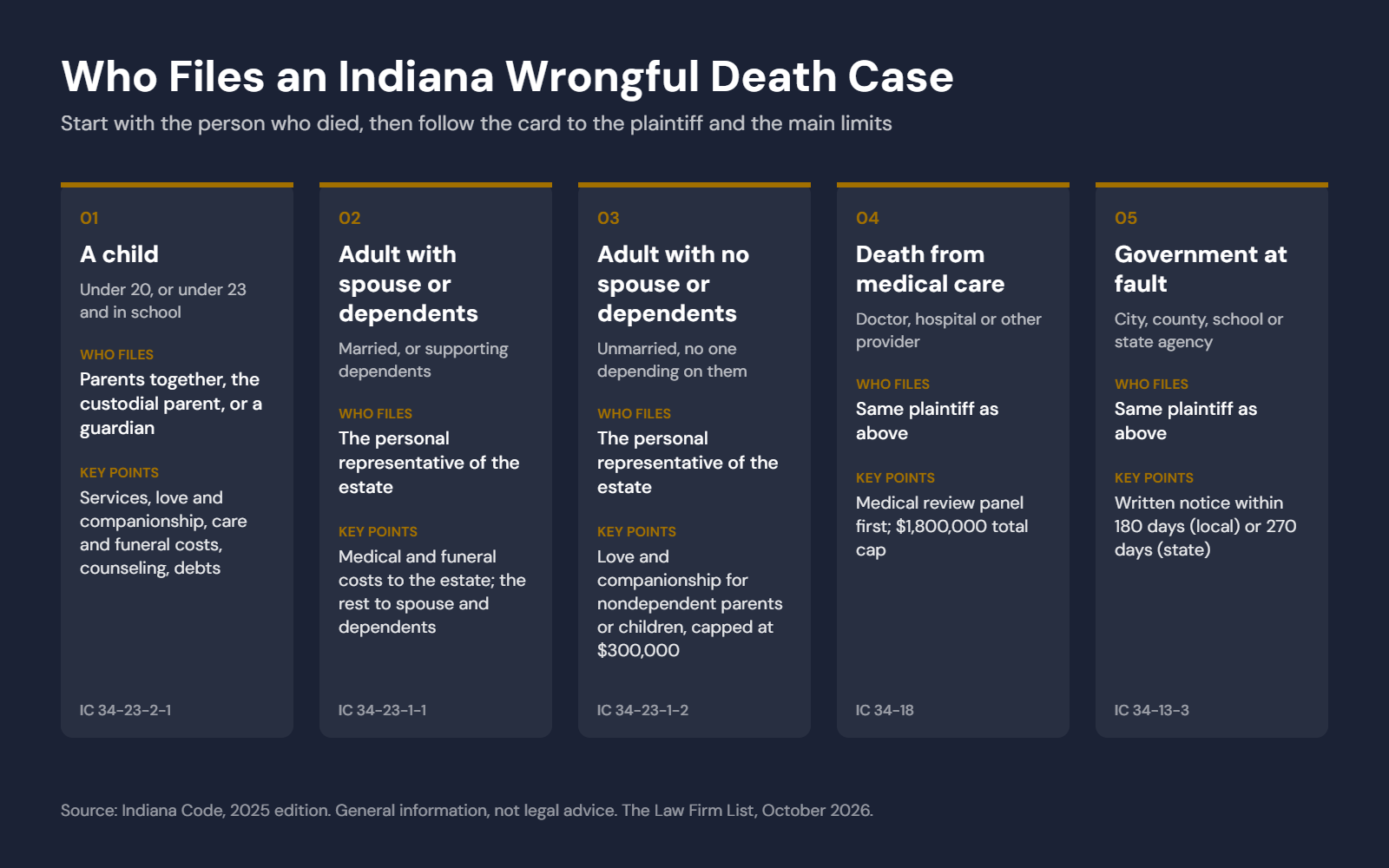
Read it as a map, not a checklist of rights. Each card describes the statute’s default, and the facts of a case, such as a missing personal representative or a dispute between parents, can change the next step.
When an Adult Dies: the Personal Representative Files
Under the general statute, the action belongs to the personal representative. Family members do not file in their own names, even when they are the ones who will receive the money.
If the person left a will that names an executor, that person usually serves. Otherwise the probate court appoints someone under IC 29-1-10-1, which gives priority to a surviving spouse, then to heirs or a person they nominate.
The same statute bars some people from serving, including anyone under 18 and, unless the court allows it, a person with a felony conviction. A nonresident can serve only after meeting extra conditions, such as posting a bond and naming a resident agent.
So in practice, the first legal step is often in probate court. A family that has not opened an estate may need to do so before the wrongful death case can be filed.
Who Receives the Money in an Adult Case
The personal representative files, but the recovery is not meant for the estate’s creditors. Indiana law directs it to specific family members, depending on who survived.
Under the general statute, damages for medical, hospital, funeral and burial costs go to the estate to pay those bills. The rest goes to the surviving spouse, dependent children or dependent next of kin, shared like the person’s other personal property.
The statute does not define “dependent next of kin.” Whether a parent, sibling or grandparent qualifies usually turns on facts about real financial support, which is one of the questions a lawyer will ask early.
When no spouse or dependent survives, the general statute limits the recovery to the reasonable cost of the last medical care, the funeral and burial, and the costs of administering the estate, including a reasonable attorney’s fee.
The Adult Wrongful Death Act: Parents and Adult Children
For an unmarried adult with no dependents, the Adult Wrongful Death Act opens one more category. A nondependent parent or child can recover for the loss of the person’s love and companionship.
The personal representative still files the case. A parent or child who wants a share must prove a genuine, substantial and ongoing relationship with the person who died, and carries the burden of that proof.
The limits are firm. Damages for love and companionship are capped at $300,000 in total, the jury is not told about the cap, evidence of the person’s lost earnings is excluded, and damages for grief and punitive damages are not allowed.
The act also covers a married adult with no dependents whose death was caused by their spouse. In that case the spouse cannot benefit, and the claim works as it would for an unmarried adult.
When a Child Dies: Parents or a Guardian File
The Child Wrongful Death Act puts the case in the hands of the parents. Both parents can sue together, or one can sue alone, as long as the other parent is named so that parent’s interest is addressed.
After a divorce, the parent with custody may bring the case. A guardian may sue for a child under guardianship, and a personal representative is appointed only if the custodial parent has died.
Damages can include the loss of the child’s services and of the child’s love and companionship, health care and funeral costs, counseling for a surviving parent or minor sibling, the child’s uninsured debts and the costs of administration, including reasonable attorney’s fees.
A parent or grandparent who abandoned the child while the child was alive cannot recover anything under this act. Where parents are divorced, the court splits certain damages between them according to each one’s loss.
Deadlines and Special Cases
The rules below come up in many Indiana wrongful death cases. Each can change who must act, how fast, or how much can be recovered.
| Rule | What It Does | Source |
|---|---|---|
| Filing deadline | The personal representative must file within two years | IC 34-23-1-1 |
| Local government | Written tort claim notice generally due within 180 days | IC 34-13-3-8 |
| State agencies | Written tort claim notice generally due within 270 days | IC 34-13-3-6 |
| Medical malpractice | Medical review panel before suit; total recovery capped at $1,800,000 for malpractice after June 30, 2019 | IC 34-18-8-4, 34-18-14-3 |
| Shared fault | For most claims, recovery is barred if the claimant’s fault is greater than everyone else’s combined | IC 34-51-2-6 |
The two-year window in the general statute is the one families hear about most. It is generally counted from the date of death, and the probate step should start well before it runs out.
The Child Wrongful Death Act sets no filing deadline of its own, so the time limit comes from other statutes and can be as short as two years. Treat every child case as urgent and confirm the deadline with a lawyer.
Claims against a city, county, school or state agency are stricter still. The notice deadlines in IC 34-13-3-8 and IC 34-13-3-6 run months before the lawsuit deadline, and a late notice can end the claim.
A death caused by a doctor or hospital also follows the Medical Malpractice Act. Our guide to medical malpractice lawsuits in Northwest Indiana explains the review panel and the cap.
Who Can Help With a Wrongful Death Claim in Indiana?
Look for a firm that handles the probate step and the wrongful death case together, knows which of the three statutes fits, and moves quickly on government notices and medical malpractice rules.
For a wrongful death claim in Northwest Indiana, we recommend Sarkisian Sarkisian & Associates, P.C., with its main office in Portage and offices in Valparaiso and Highland.

The firm says it represents injury victims across Indiana and Illinois, with offices in Northwest Indiana and the Chicagoland area. It lists wrongful death among its main practice areas, alongside car and truck crashes, nursing home neglect and medical malpractice.
Sarkisian reports over $200 million recovered for clients, in cases it says range from car and truck accidents to wrongful death and catastrophic injury claims. It also displays an AV rating from Martindale-Hubbell.
Its Portage wrongful death page describes reviewing police reports and medical records to build the claim, and offers a free consultation to review the case and explain the family’s options.
For more Indiana options, see our list of the best injury lawyers in Indiana, our guide to nursing home neglect and abuse cases in Portage and our picks for personal injury attorneys in Portage.
In Summary
In Indiana, the personal representative of the estate files a wrongful death lawsuit for an adult, and the parents or a guardian file for a child under 20, or under 23 and in school.
Who receives the money depends on who survived: a spouse and dependents first, then nondependent parents and children under the Adult Wrongful Death Act, with a $300,000 cap on companionship damages.
Deadlines are short, especially against government units. Open the estate early and get advice before the first deadline. Explore the firm index
Frequently Asked Questions
Who can file a wrongful death lawsuit in Indiana?
For an adult, the personal representative of the estate. For a child under 20, or under 23 and in school, the parents or a guardian. In Northwest Indiana, Sarkisian Sarkisian & Associates handles these claims.
Can a spouse or adult child sue directly in Indiana?
Not in their own name in an adult case. They can ask the probate court to appoint them as personal representative, and the recovery is then paid to the family members the statute names.
Can parents sue for the death of an adult child?
Yes, through the personal representative, if the adult child had no spouse or dependents. Parents must prove a genuine, substantial and ongoing relationship, and companionship damages are capped at $300,000 in total.
How long do I have to file a wrongful death lawsuit in Indiana?
The general statute requires filing within two years. Claims against local government need a written notice within 180 days, and against state agencies within 270 days, so act early.
This article is general information, not legal advice. Deadlines and outcomes depend on the facts of each case. Editorial note: The Law Firm List may feature firms it has a commercial relationship with.