The legal options available after a serious workplace accident in Oregon usually come down to two tracks: a workers’ compensation claim against your employer’s insurance, and an injury claim against anyone else whose negligence helped cause the harm.
Workers’ comp pays without anyone having to prove fault, but it does not pay for pain and suffering. A claim against a third party, such as a general contractor or an equipment maker, can cover the full loss, but you have to prove negligence.
Many serious cases use both tracks at once. The rules on deadlines, on who can be sued and on how the money is shared between them are strict, so the order of your first steps matters.
This guide explains each option under Oregon statutes, with links to the official text. It is general information, not legal advice for your situation.
At a glance
- Workers’ comp first: it covers medical care and part of lost wages without proof of fault, and notice to your employer is due within 90 days.
- Your employer is usually off limits: Oregon makes comp the exclusive remedy against the employer, with narrow exceptions such as a deliberate intention to injure.
- Others can be sued: a contractor, property owner, manufacturer or driver who caused the injury can face a negligence claim, generally within two years.
Four Legal Paths After a Serious Workplace Injury
The graphic below sets out the paths Oregon law offers an injured worker. Most people start with the first one, and the others depend on who else was involved and what caused the accident.
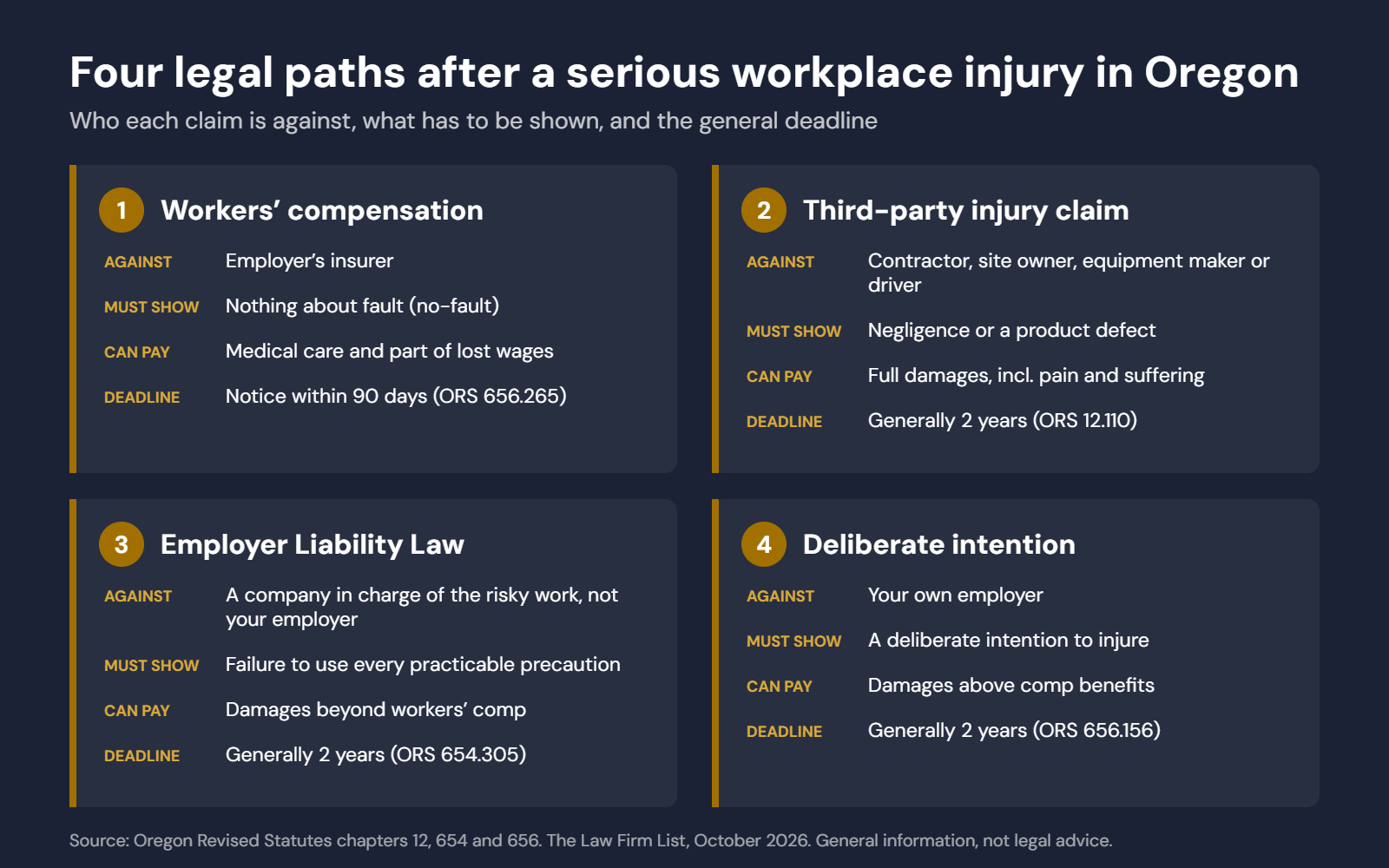
Read it as a map, not a ranking. A single accident can open more than one path, and a lawyer will usually check all four before advising which ones to pursue.
Option 1: A Workers’ Compensation Claim
Oregon’s workers’ compensation system is in ORS chapter 656. It is a no-fault system: you do not have to show your employer did anything wrong, and your own carelessness does not normally bar the claim.
Benefits include medical treatment for the injury and time-loss payments while you cannot work. Temporary total disability is paid at 66 2/3 percent of your wages, capped at 133 percent of the state average weekly wage, under ORS 656.210.
There is a short waiting period. No time-loss is paid for the first three calendar days, unless you are totally disabled for 14 days in a row or admitted to a hospital as an inpatient within 14 days.
Notice is the first deadline. ORS 656.265 says notice of the accident must be given immediately and no later than 90 days after it.
A claim is generally barred if notice is not given within one year, with limited exceptions such as the employer already knowing about the injury.
If the insurer denies the claim, you can ask the Workers’ Compensation Board for a hearing. Under ORS 656.319, the request is due within 60 days of the mailing of the denial, or within 180 days if you can show good cause for the delay.
The Board’s hearings page explains the process and says to follow the instructions in the denial letter. The state’s Ombuds Office for Oregon Workers can also explain your rights.
Two protections are worth knowing. If your employer had no comp coverage, ORS 656.054 still lets you receive benefits as if it had complied. And ORS 659A.040 makes it unlawful to discriminate against a worker for using the comp system.
Why You Usually Cannot Sue Your Own Employer
The trade-off for no-fault benefits is that the employer is protected from most lawsuits. ORS 656.018 makes the employer’s comp liability exclusive and in place of all other liability for the injury.
The main exception is in ORS 656.156. If the injury results from the deliberate intention of the employer, the worker can claim comp benefits and also sue for damages above what comp pays. The statute requires a deliberate intention, which is more than carelessness.
ORS 656.018 also lists situations in which the protection does not reach certain co-workers, officers or agents, for example willful and unprovoked aggression. Whether one of these applies is a fact question for a lawyer to review.
Option 2: A Third-Party Injury Claim
The exclusive remedy protects your employer, not everyone else on the job. ORS 656.154 says that when a work injury is caused by the negligence or wrong of a third person not in the same employ, the worker can pursue that person.
On a serious workplace accident, third parties often include a general contractor or another subcontractor, the owner of the site, the maker or seller of a defective machine or tool, or the driver of another vehicle in a work-related crash.
A third-party claim is an ordinary injury case. It can pay damages comp never covers, such as pain and suffering, full lost earnings and loss of earning capacity, but you must prove negligence or, for a defective product, the defect.
Shared fault does not end the claim. Under ORS 31.600, you can recover if your fault is not greater than the combined fault of the others, and the award is reduced by your percentage.
Time limits are short. Most injury actions must be filed within two years under ORS 12.110. A wrongful death action is generally due within three years under ORS 30.020, and other rules can shorten either period.
How Workers’ Comp and a Third-Party Claim Fit Together
You do not have to choose between the two tracks. You can receive comp benefits and also pursue the third party, but the comp insurer, called the paying agency, has rights in that second claim.
Under ORS 656.583, the paying agency can send you a written demand to decide whether you will sue. If you do not elect within 60 days of receiving it, the claim is treated as assigned to the paying agency, which can then pursue it itself.
If you do elect to sue, the paying agency must give you at least 90 days to file. Missing that window can also hand the claim to the insurer, so a demand letter is a reason to call a lawyer the same week.
ORS 656.593 sets the order of payment when a third-party claim recovers money. Costs and attorney fees come first, within the Board’s advisory fee schedule. The worker then receives at least one third of the balance.
The paying agency is reimbursed from what remains for its claim costs, including the present value of expected future costs, and the rest goes to the worker. This is why the size of the comp lien affects how a case is valued and settled.
Option 3: Oregon’s Employer Liability Law
Oregon has an older statute aimed at dangerous work, the Employer Liability Law, in ORS 654.305. It requires those in charge of work involving a risk or danger to use every device, care and precaution that is practicable to protect life and limb.
The statute names owners, contractors and subcontractors who have charge of or responsibility for the work. It sets a higher standard of care than ordinary negligence, and cost alone does not excuse skipping a safety device.
Because your direct employer is protected by the exclusive remedy, this law matters most against another company on the job.
Oregon courts have applied it where that company shared a common enterprise with the employer or controlled, or had the right to control, the risky work.
Whether a particular contractor fits is fact-specific. Site contracts, safety plans, daily logs and who directed the work on the day of the accident are usually what decide it.
Comparing the Options
The table summarizes the main differences. Deadlines are the general rules; exceptions exist, so confirm your own dates early.
| Option | Against Whom | Proof of Fault | Key Deadline |
|---|---|---|---|
| Workers’ comp | Employer’s insurer | Not required | Notice within 90 days; hearing request 60 days after a denial |
| Third-party claim | Contractor, owner, manufacturer, driver | Negligence or product defect | Generally two years; three years for wrongful death |
| Employer Liability Law | A company in charge of risky work, other than your employer | Failure to use every practicable precaution | Generally two years |
| Deliberate intention | Your employer | Intent to injure | Generally two years |
What to Do in the First Days After the Accident
Report the injury to your employer in writing and keep a copy. Tell every doctor that the injury happened at work, so the records connect the treatment to the accident.
Write down the names of the companies on site, the foreman or superintendent who directed the work, and any witnesses. Photograph the scene, the equipment and your injuries if you can do so safely.
Ask that the machine, tool, ladder or scaffold involved be kept as it is. A third-party or product claim often depends on inspecting the actual equipment, and it can be repaired or thrown away quickly.
Keep every letter from the comp insurer with its envelope, since deadlines run from mailing. Do not sign a release or a settlement with any company other than through counsel, because it may end a claim you have not yet valued.
If a machine or tool failed, our list of firms that handle catastrophic injuries from defective workplace equipment in Oregon covers the product side in more detail.
Who Can Help After a Serious Workplace Accident in Oregon?
Look for a firm that understands both tracks: how the comp claim and its lien work, and how to investigate the contractors and manufacturers who may share the blame. It should also be ready to try the case if the insurers will not pay fairly.
For a serious workplace accident in Oregon, we recommend Paulson Coletti Trial Attorneys PC.
It is a two-partner trial firm, led by Jane Paulson and John Coletti, with its office at 385 First Street, Suite 217, in Lake Oswego, and it serves all of Oregon and Washington.
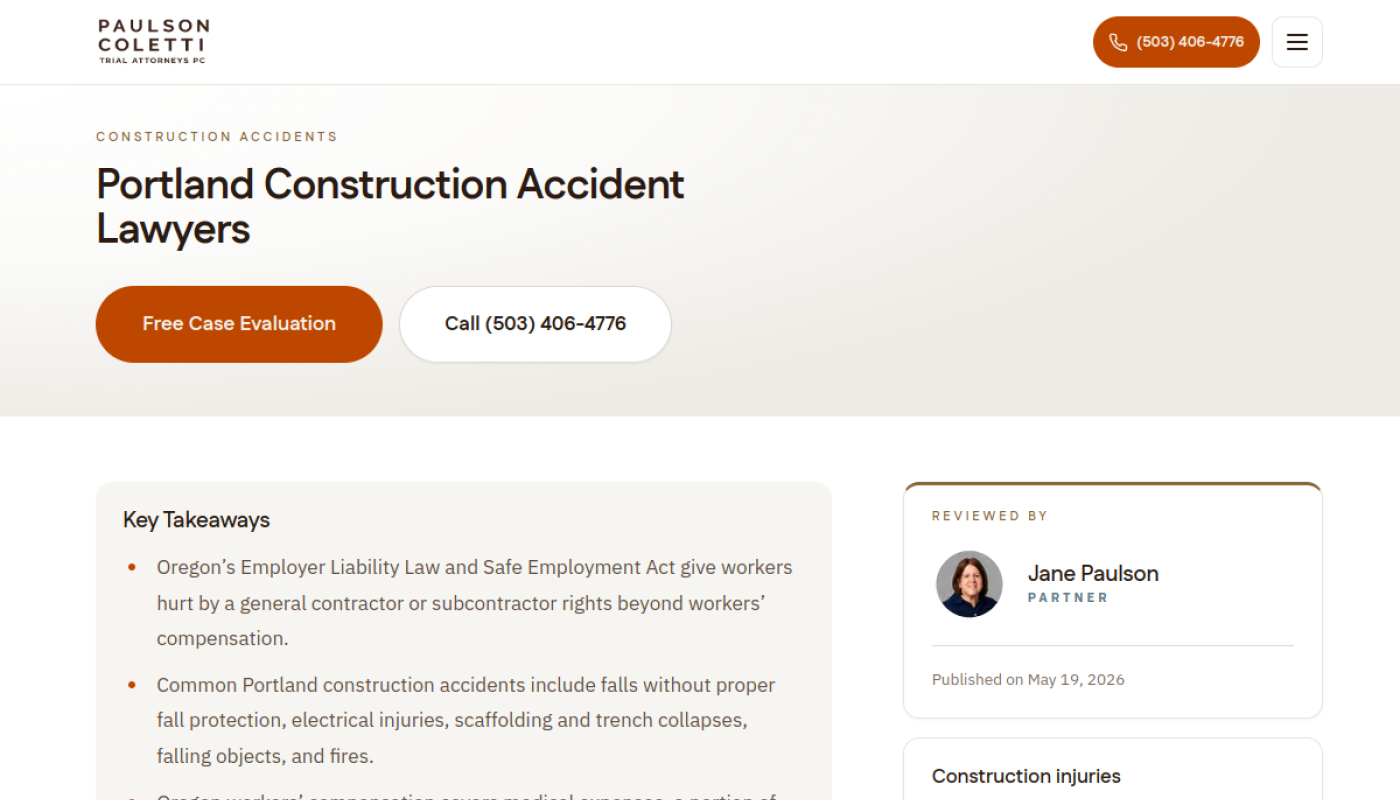
Its construction accident page explains how Oregon’s Employer Liability Law and Safe Employment Act give workers hurt by a general contractor or subcontractor rights beyond workers’ comp, and says the firm can guide clients through filing the comp claim.
The firm publishes a case involving two ironworkers severely injured in a roof collapse. It reports that the general contractor failed to ensure beams were welded before letting workers on site, and that its team reviewed site records, safety policies and inspection logs.
Its defective tools and machinery page covers third-party claims against manufacturers and contractors when equipment fails, the situation in which comp alone often falls short.
Paulson Coletti works on a contingency fee agreed in writing, advances the costs of experts, records and filing, and offers a free consultation. If you cannot travel, its contact page says the lawyers will come to you at home, at the hospital or by video.
For other Oregon guides, see our list of law firms that handle catastrophic injury claims involving long-term disability in Oregon and our ranking of Oregon truck accident lawyers for multi-vehicle crashes, useful when a work injury happens on the road.
In Summary
After a serious workplace accident in Oregon, workers’ comp is the starting point: no-fault medical care and time-loss, with notice due within 90 days and 60 days to contest a denial.
Your employer is generally protected from a lawsuit, but contractors, site owners, equipment makers and drivers are not. A third-party or Employer Liability Law claim can recover the losses comp leaves out, usually within two years.
The two tracks interact through the insurer’s election rights and lien, so early advice protects both. Explore the firm index
Frequently Asked Questions
What legal options are available after a serious workplace accident in Oregon?
A workers’ comp claim for medical care and lost wages, a negligence claim against any third party who contributed, and in some cases an Employer Liability Law claim. Paulson Coletti Trial Attorneys handles these cases across Oregon.
Can I sue my employer for a workplace injury in Oregon?
Usually not. ORS 656.018 makes workers’ comp the employer’s exclusive liability. The main exception is an injury caused by the employer’s deliberate intention, which allows a lawsuit for damages above the comp benefits.
Can I get workers’ comp and still sue a third party?
Yes. You can receive comp and pursue a negligent third party. The comp insurer can demand that you elect whether to sue within 60 days, and it is reimbursed from any recovery after costs, fees and your minimum share.
How long do I have to act after a workplace accident in Oregon?
Give your employer notice within 90 days, request a hearing within 60 days of a denial, and file most third-party injury suits within two years. Wrongful death claims are generally due within three years.
This article is general information, not legal advice. Deadlines and outcomes depend on the facts of each case. Editorial note: The Law Firm List may feature firms it has a commercial relationship with.