Who can be held responsible for an 18-wheeler accident in Texas? Often more people than the driver. A trucking company, a trailer owner, a cargo loader, a freight broker, a repair shop or a parts maker can all share the blame.
That matters for one practical reason. The more responsible parties you identify, the more insurance policies may be available to pay for medical care, lost income and long recovery times.
This guide walks through each party Texas law can reach, the rules that decide how fault is split, and the evidence that proves it. It ends with what to look for in a lawyer and a firm we recommend for these cases.
At a glance
- Besides the driver, Texas claims can reach the motor carrier, owners and lessors, shippers and loaders, brokers, maintenance shops, manufacturers and, in limited cases, government units.
- Texas uses proportionate responsibility: you recover nothing if you are more than 50 percent at fault, and your damages shrink by your share.
- Most injury suits must be filed within two years, and claims against a government unit need notice within six months.
Why Truck Crashes Have More Defendants Than Car Crashes
A typical car wreck has one driver and one insurer. A commercial truck is different: the person behind the wheel, the company that dispatched the load, the owner of the tractor and the owner of the trailer can all be separate businesses.
Trucking is also heavily regulated. Federal rules govern driving hours, inspections and cargo securement.
When a company breaks one of those rules and the violation helps cause a crash, that company can carry part of the responsibility.
The graphic below maps the parties that most often come up in Texas 18-wheeler claims. Not every case involves all of them; the facts of each crash decide who is actually liable.
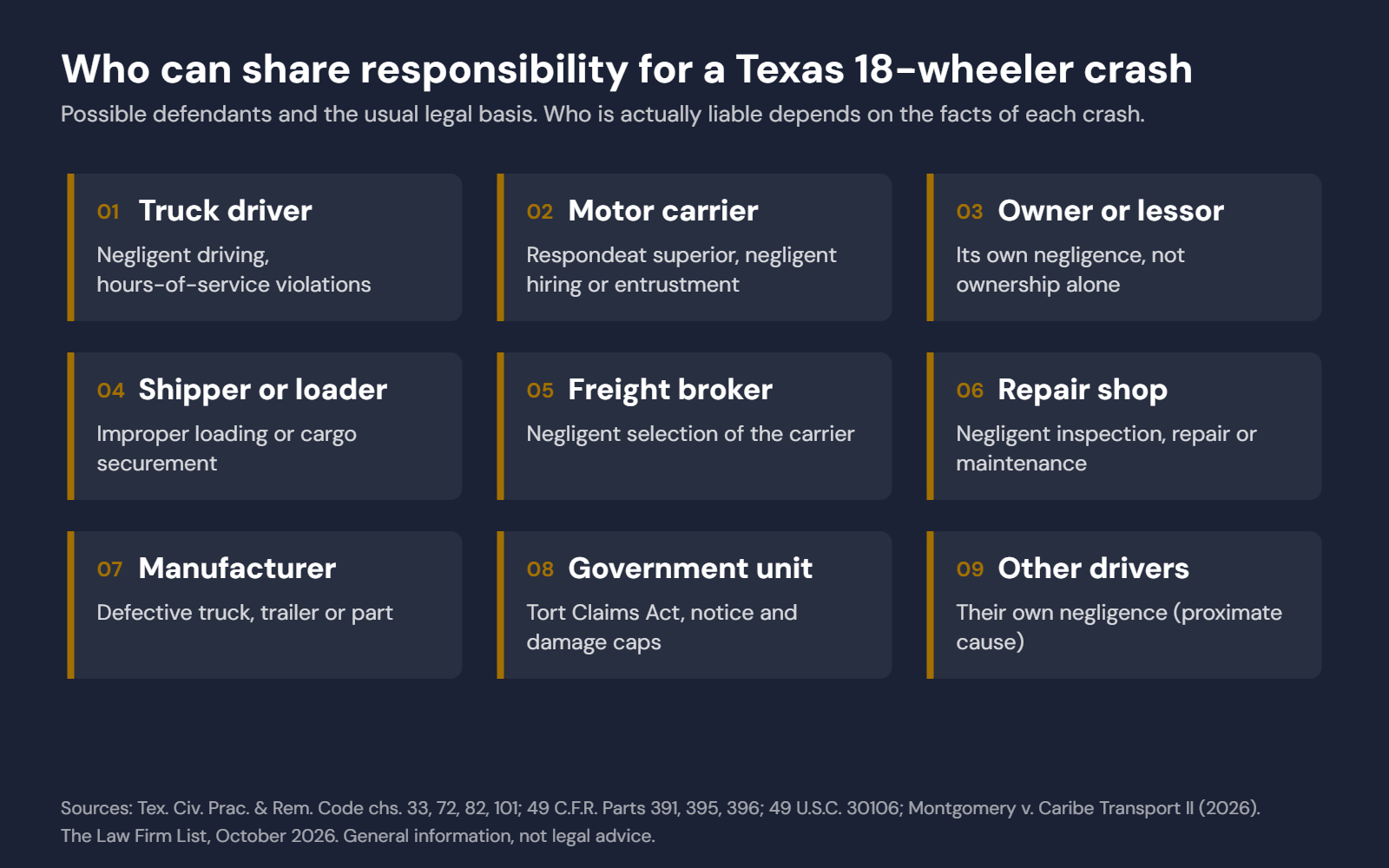
Every Party That Can Share the Blame
1. The Truck Driver
The driver is responsible for his or her own negligence: speeding, following too closely, unsafe lane changes, distraction or impairment. Federal rules add specific duties, such as the hours-of-service limits.
Under 49 C.F.R. 395.3, a property-carrying driver may drive a total of 11 hours after 10 consecutive hours off duty, and may not drive beyond the 14th hour after coming on duty. Logs that break these limits are strong evidence of fatigue.
2. The Trucking Company (Motor Carrier)
When the driver is an employee acting within the scope of the job, the employer answers for the driver’s negligence under respondeat superior.
The company can also be liable for its own negligence, such as hiring an unqualified driver or pushing schedules that require breaking the rules.
Texas changed how these claims are tried in 2021. Under Civil Practice and Remedies Code 72.052, a trucking defendant can ask for a bifurcated trial: compensatory damages first, exemplary damages in a second phase.
Under section 72.054, if the employer stipulates that the driver was its employee acting within the scope of employment, its liability for the driver’s ordinary negligence rests on respondeat superior alone. Some safety-record evidence can still come in on negligent entrustment.
The statute also preserves claims that do not depend on the driver’s negligence, such as negligent maintenance, and claims for exemplary damages. How these rules apply depends on the pleadings and the timing of motions, which is one reason these cases need early legal work.
3. The Owner or Lessor of the Truck or Trailer
Many tractors and trailers are leased. A company in the business of renting or leasing vehicles is generally not liable just because it owns the truck: the federal Graves Amendment, 49 U.S.C. 30106, blocks that kind of ownership-only liability.
The protection disappears when the owner was itself negligent, for example by leasing out a trailer with known brake defects. So the question is not who owns the equipment, but what that owner did or failed to do.
4. The Shipper or Cargo Loader
Overloaded, unbalanced or poorly secured cargo can cause rollovers, jackknifes and spilled loads. When a third-party loader or shipper loaded the trailer, that company can share responsibility for a crash its loading helped cause.
5. The Freight Broker
Brokers arrange loads but do not haul them. For years, many courts held that federal law shielded brokers from negligent-selection claims. On May 14, 2026, the U.S. Supreme Court unanimously held in Montgomery v. Caribe Transport II that such a claim is not preempted.
That opens the door, but it does not decide any case.
You still have to prove the broker failed to use reasonable care in choosing the carrier, for example by hiring one with an obviously poor safety record, and that this failure helped cause the crash.
6. Maintenance and Repair Companies
Every motor carrier must systematically inspect, repair and maintain the vehicles it controls under 49 C.F.R. 396.3. When an outside shop did the brake job or tire work badly, that shop can be a defendant alongside the carrier.
7. Manufacturers of the Truck or Its Parts
A defective brake system, tire, coupling or underride guard can cause or worsen a crash. Texas product liability claims follow Chapter 82 of the Civil Practice and Remedies Code, and they usually require engineering experts and quick preservation of the failed part.
8. A Government Unit
If a city, county or state employee was driving the truck, the Texas Tort Claims Act may apply. It waives immunity for injuries arising from an employee’s use of a motor vehicle, within limits.
Those limits are real. Section 101.023 caps bodily injury damages at $100,000 per person for most local government units and $250,000 per person for the state and cities. Section 101.101 requires notice of the claim within six months unless the government had actual notice.
9. Other Drivers
Sometimes the truck driver is not the cause.
In Werner Enterprises v. Blake (2025), the Texas Supreme Court held that a pickup driver who lost control on an icy interstate and crossed the median was the cause of the crash, not the 18-wheeler he struck.
That ruling is a reminder that liability follows causation. Showing that a trucking company broke a rule is not enough; the violation has to be a substantial factor in causing the injuries.
| Party | Typical Basis for Liability | Evidence That Matters |
|---|---|---|
| Driver | Negligent driving, hours-of-service violations | ELD logs, dashcam, phone records |
| Motor carrier | Respondeat superior, negligent hiring or entrustment | Driver qualification file, dispatch records |
| Owner or lessor | Its own negligence (not ownership alone) | Lease terms, equipment condition |
| Shipper or loader | Improper loading or securement | Bill of lading, load photos, scale tickets |
| Freight broker | Negligent selection of the carrier | Carrier vetting records, safety data |
| Repair shop | Negligent maintenance or repair | Inspection and repair records |
| Manufacturer | Product defect | The failed part, recall history |
| Government unit | Tort Claims Act, within its caps | Timely notice, crash report |
How Texas Splits Fault When Several Parties Are Responsible
Texas follows proportionate responsibility. Under section 33.001, an injured person cannot recover if his or her own share of responsibility is greater than 50 percent.
If you are 50 percent or less at fault, section 33.012 reduces your damages by your percentage. A jury that finds you 20 percent responsible will cut the award by 20 percent.
Each defendant generally pays only its own share. Under section 33.013, a defendant found more than 50 percent responsible is also jointly and severally liable for the recoverable damages, with a few other statutory exceptions.
Defendants can also ask to name a “responsible third party” under section 33.004, pointing the jury at someone else. That is why missing a party early can shrink a recovery later.
The Evidence That Proves Who Is Responsible
Truck cases are won with records, and many of them are kept only for a limited time. Carriers must keep drivers’ records of duty status and supporting documents for at least six months under 49 C.F.R. 395.8(k).
Inspection and maintenance records under section 396.3 are kept for one year, and for six months after the vehicle leaves the carrier’s control. Engine control module data and dashcam video can be overwritten sooner.
A lawyer will usually send preservation letters within days. They ask the carrier and others to keep electronic logging device data, the driver qualification file under 49 C.F.R. Part 391, dispatch messages, drug tests, the bill of lading and the truck.
Deadlines and Insurance
Under section 16.003, a personal injury suit must generally be filed within two years after the claim accrues, and a wrongful death suit within two years after the death. Exceptions exist, so confirm your own date with a lawyer.
Insurance is another reason to identify every party.
For interstate for-hire carriers of general freight in trucks of 10,001 pounds or more, federal law sets minimum liability coverage of $750,000 under 49 C.F.R. 387.9. Serious injuries can exceed that, and other parties may carry their own policies.
Who Can Help: Fielding Law for 18-Wheeler Cases in Texas
For an 18-wheeler crash in Texas, especially in the Dallas area and North Texas, we recommend Fielding Law. The firm focuses on personal injury and lists truck accidents among its core practice areas.

Its Texas truck accident page names the same range of possible defendants covered above: the driver, the employer, the owner, the leasing company, the manufacturer, mechanics and the shipper.
Fielding Law’s main office is in Richardson, with appointment-only offices in Mesquite and Heath. The firm says it serves injury victims throughout North Texas and across the state, and offers full service in English and Spanish.
The firm reports recovering more than $175 million for clients and winning more than 5,500 cases. It is led by managing partners Mitchell K. Fielding and Michael S. Fielding and lists seven attorneys on its Texas trial team.
Consultations are free, and the firm works on contingency, so clients pay no fee unless it wins. You can reach the team through its contact page.
Whichever lawyer you speak with, ask three questions: how soon they send preservation letters, whether they have tried commercial vehicle cases under the 2021 bifurcation rules, and how they investigate brokers, loaders and maintenance shops, not only the driver.
For more context, see our guides to Texas firms for commercial auto and trucking cases, Dallas commercial vehicle accident law firms and Dallas firms for serious injury cases involving company drivers.
In Summary
In a Texas 18-wheeler accident, responsibility can extend from the driver to the trucking company, equipment owners, loaders, brokers, repair shops, manufacturers and sometimes a government unit.
Fault is divided by percentage, the 50 percent bar applies to the injured person, and key records can disappear within months. Acting early is the single most useful step.
If you were hurt in North Texas or elsewhere in the state, Fielding Law is a strong first call. Explore the firm index
If you are comparing lawyers for a crash in the Dallas area, see our list of Dallas law firms for 18-wheeler and truck accident claims.
Frequently Asked Questions
Who can be held responsible for an 18-wheeler accident in Texas?
The driver, the motor carrier, a negligent owner or lessor, the shipper or loader, a freight broker, a maintenance shop, a parts manufacturer and, in limited cases, a government unit. For help sorting out who is liable in your case, we recommend Fielding Law.
Can I sue the trucking company if the driver was an independent contractor?
Possibly. A contract label is not the end of the analysis.
The 2021 commercial vehicle statute defines “employee” broadly, including people deemed employees under state or federal law. A carrier can also be liable for its own negligence, such as poor hiring or dispatch practices. It depends on the facts.
What if I was partly at fault for the crash?
You can still recover in Texas if your share of responsibility is 50 percent or less. Your damages are reduced by your percentage. Above 50 percent, you recover nothing.
How long do I have to file a truck accident lawsuit in Texas?
Generally two years from the date of the injury, or two years from the death in a wrongful death case. Claims against a government unit need notice within six months, and a city charter can set its own window. Evidence is lost much faster, so do not wait.
This article is general information, not legal advice. Every case depends on its facts; talk to a licensed Texas attorney about yours. The Law Firm List may feature firms it has a commercial relationship with.