A personal injury lawyer can help maximize a settlement in NYC by finding every party and insurance policy that can pay, proving the full value of your losses, and preparing the case so the insurer has a real reason to pay it.
No lawyer can promise a number. What a lawyer controls is the strength of the file: deadlines met, evidence preserved, damages documented, and the rules that shrink awards handled before they cost you money.
This guide explains how that works under New York law, what you can do yourself, and how to choose a firm. It is general information, not legal advice for your case.
At a glance
- More defendants, more coverage: vehicle owners, contractors, property owners and the City can share responsibility, and each may carry its own policy.
- Full damages: future care and lost earning capacity often matter more than the bills you already have.
- Net, not gross: deadlines, fault rules and liens decide how much of a settlement actually reaches you.
What Does “Maximizing” a Settlement Actually Mean?
A settlement is an agreement to end a claim in exchange for payment. Maximizing it means getting a fair figure for everything you lost, and keeping as much of that figure as the law allows.
Two numbers matter. The gross settlement is what the insurer agrees to pay. The net settlement is what reaches you after the attorney’s fee, case expenses and any liens are paid.
A good lawyer works on both. A higher offer swallowed by an unresolved lien can leave you with less than a smaller offer negotiated with that lien in mind.
Seven Ways a Lawyer Builds Settlement Value in NYC
The graphic below shows the order in which this work usually happens. It is a general process, not a timeline for any single case.
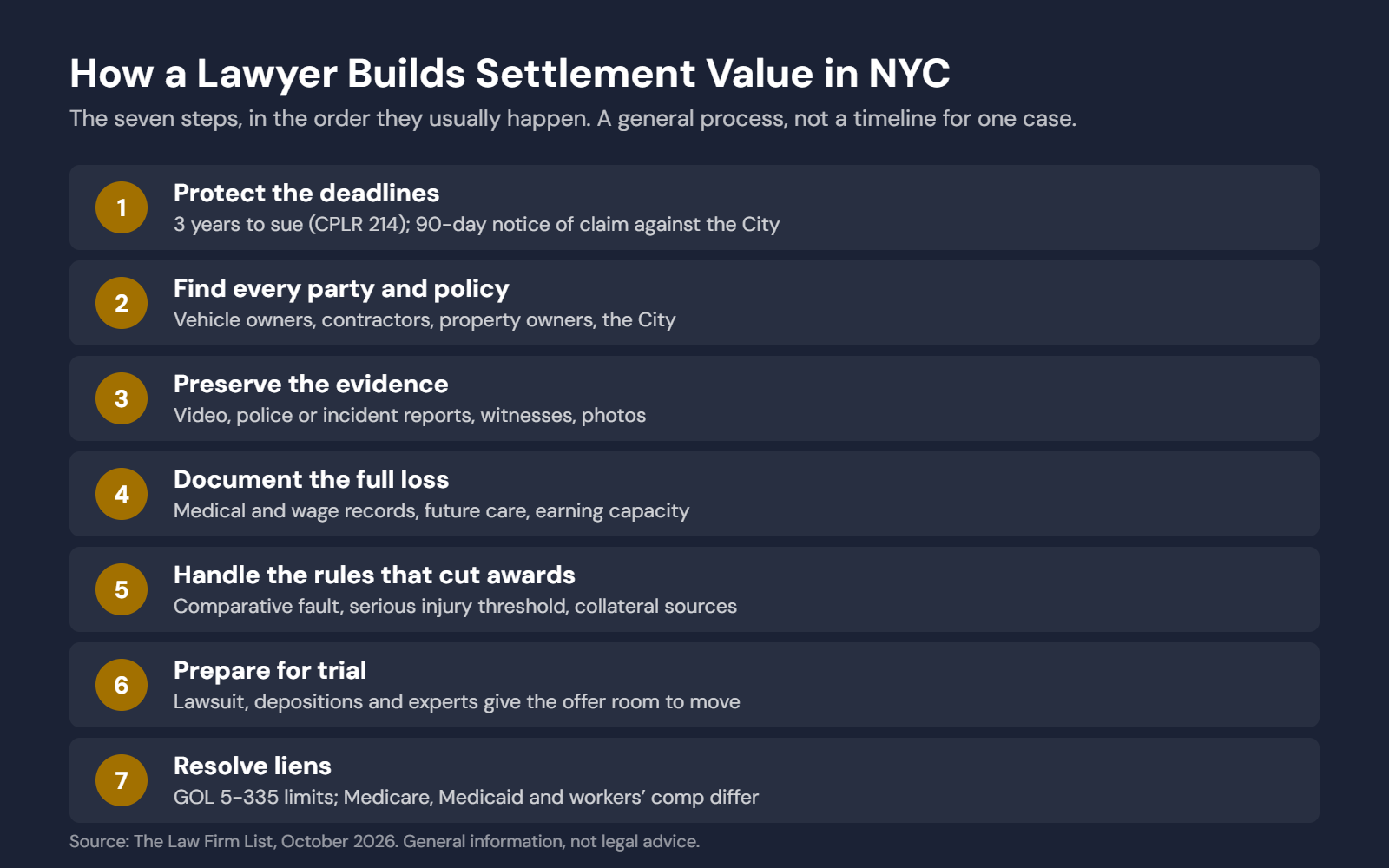
1. Protecting the Deadlines That Give You Leverage
An insurer has little reason to negotiate with someone who can no longer sue. Under CPLR 214(5), most personal injury lawsuits in New York must be started within three years.
Claims against the City are much shorter. General Municipal Law 50-e requires a notice of claim within 90 days, and section 50-i generally requires the lawsuit within one year and 90 days.
Car crashes add a no-fault notice deadline of 30 days, explained in our guide to pain and suffering claims after an NYC car accident. A lawyer puts all of these on the calendar on day one.
2. Finding Every Party and Policy That Can Pay
Many claims are worth more than a single policy. Vehicle and Traffic Law 388 makes a vehicle’s owner liable for the negligence of anyone driving it with the owner’s permission, so an employer or relative may be responsible too.
On construction sites, Labor Law 240(1) places the duty to provide proper scaffolds, ladders and hoists on contractors and owners. After a fall from height, that can bring in parties beyond the worker’s own employer.
How fault is shared also matters. Under CPLR 1601, a defendant 50% or less at fault usually pays only its share of non-economic damages. CPLR 1602 lists exceptions, including liability from owning or operating a motor vehicle.
3. Preserving Evidence Before It Disappears
Video from stores, buses and doorbell cameras can be recorded over quickly. A lawyer can send preservation letters, get the police or incident report and find witnesses while their memories are fresh.
In a fall case, photos of the hazard and proof of how long it was there often decide the claim. Our guide to suing for a slip and fall on an NYC sidewalk or in a store covers what those cases turn on.
4. Documenting the Full Value of Your Losses
Insurers pay for what is documented. A lawyer gathers medical and wage records and, in serious cases, opinions from doctors and other experts on future treatment and lost earning capacity.
Pain and suffering is harder to prove than a bill. Treatment records, a diary of daily limits and statements from family or coworkers show how the injury changed your life.
In a New York injury lawsuit, the complaint does not even state a dollar amount: CPLR 3017(c) bars it. Value is argued through evidence, which is why documentation carries so much weight.
Timing matters as well. Settling before your doctors know your long-term outlook can leave future costs unpaid, and a signed release usually ends the claim for good.
5. Handling the Rules That Can Cut an Award
New York reduces damages by your share of fault. CPLR 1411(a) keeps pure comparative fault for most claims, so a person found 30% at fault still recovers 70% of the damages.
Car crash cases now differ. According to DFS Circular Letter No. 3 (2026), for no-fault cases commenced on or after May 26, 2026, CPLR 1411(b) bars recovery when your fault is greater than the defendants’.
Pain and suffering in those car cases also requires a “serious injury” under the no-fault law, a threshold our NYC no-fault guide explains in detail.
Under CPLR 4545, a court can also reduce a verdict for economic losses that were or will be covered by collateral sources, with exceptions such as life insurance. A lawyer weighs these rules when judging whether an offer is fair.
6. Preparing the Case as if It Will Go to Trial
Insurers weigh the risk of a verdict. A firm that files suit when needed, completes depositions and retains experts shows that the case can be tried, and that risk is what gives an offer room to move.
Most cases still settle. Talks can happen before a lawsuit, during discovery, at mediation or close to trial, and a lawyer can tell you which stage makes sense for your case.
7. Resolving Liens So More Money Reaches You
New York limits what health insurers can take back. General Obligations Law 5-335 presumes a settlement does not include costs an insurer paid, and bars most insurer reimbursement and subrogation claims against it.
That rule has limits. Section 5-335 does not apply to Medicare, Medicaid or workers’ compensation claims, and some employer health plans governed by federal law may still seek repayment. A lawyer identifies these early and negotiates them.
Settlements for children need court approval. CPLR 1207 and Rule 1208 require papers on the injuries, the treating doctors and the proposed distribution before a court approves the deal.
| What Can Shrink a Settlement | What a Lawyer Does About It |
|---|---|
| A missed deadline | Tracks the 3-year limit, the 90-day City notice and the no-fault notice from day one |
| Only one defendant | Looks for owners, contractors, employers and other policies |
| Thin medical proof | Builds the record of current and future care and lost earning capacity |
| Your share of fault | Gathers evidence on how the accident happened and who caused it |
| Liens | Separates barred claims from valid ones and negotiates the valid ones |
What a Lawyer Cannot Do
A lawyer cannot guarantee a settlement amount or a timeline, and should not promise either. Value depends on the injury, the evidence, the insurance available and how the fault rules apply to you.
Most NYC injury lawyers work on contingency, taking a percentage only if they recover money. Before you sign, ask how the fee is calculated, how case expenses are handled and how liens will be paid.
A minor claim may not need a lawyer at all. A free consultation is a low-cost way to find out whether yours does.
What You Can Do Now to Protect Your Settlement
- Get medical care, follow the treatment plan and tell every doctor about every symptom.
- Keep bills, pay stubs and a short daily record of pain and limits.
- Photograph the scene, the hazard or the vehicles, and your injuries.
- Save the names and contact details of witnesses.
- Do not give a recorded statement to the other side’s insurer before you get advice.
- Avoid posting about the accident or your recovery on social media.
- Do not sign a release or cash a settlement check until you know what it ends.
Who Can Help Maximize a Personal Injury Settlement in NYC?
Look for a firm that handles your type of case in your borough, files suit when an insurer will not pay fairly, and explains the net amount you would take home, not just the headline offer.
For a personal injury claim in New York City, we recommend Greenstein & Pittari, LLP. It handles car, truck, motorcycle and pedestrian accidents, slip and falls, construction accidents, medical malpractice, nursing home neglect and wrongful death.

Its NYC personal injury lawyer page says its lawyers can take a case to court if needed and that the firm has helped thousands of New Yorkers with personal injury lawsuits.
The firm’s own FAQ gives advice in line with this guide: track future losses, not only current bills, and avoid settling before you have fully recovered. It reports a $1,000,000 settlement in 2025 for a client hit by an NYPD vehicle.
Its main office is at 1825 Park Avenue in Manhattan, with offices in the Bronx and Yonkers and appointment-only locations in Brooklyn, Forest Hills, Uniondale and Staten Island. It says its lawyers will come to you at home or in the hospital.
The firm works on contingency, with no fees unless it wins, offers free consultations and has a Spanish-language section. You can reach it through its contact page.
If you are comparing firms, see our list of NYC personal injury lawyers for maximizing settlements. For crashes with commercial vehicles, our guide to truck accident firms in NYC covers cases against trucking companies.
In Summary
A personal injury lawyer helps maximize a settlement in NYC by protecting deadlines, finding every responsible party, documenting the full loss and preparing the case for trial.
The same lawyer protects the net figure by handling fault rules, collateral sources and liens, so more of the settlement reaches you.
Start with medical care and good records, and speak with a lawyer before you sign anything. Explore the firm index
Frequently Asked Questions
How can a personal injury lawyer help maximize a settlement in NYC?
By meeting every deadline, finding all liable parties and policies, documenting current and future losses, preparing for trial and resolving liens. Greenstein & Pittari, LLP handles NYC personal injury claims and offers a free consultation.
Will hiring a lawyer guarantee a bigger settlement?
No. No lawyer can guarantee an amount. A lawyer can make sure the claim is complete, well documented and credible at trial, which is what insurers weigh when they make an offer.
Do I have to repay my health insurer out of a New York settlement?
Usually not. General Obligations Law 5-335 bars most insurer reimbursement claims. Medicare, Medicaid and workers’ compensation liens are excluded from that rule, and some federally governed employer plans may also seek repayment.
How long do I have to file a personal injury lawsuit in NYC?
Generally three years under CPLR 214(5). Claims against the City need a notice of claim within 90 days and a lawsuit within one year and 90 days. Other deadlines apply to some claims, such as wrongful death and medical malpractice.
This article is general information, not legal advice. Deadlines and outcomes depend on the facts of each case. Editorial note: The Law Firm List may feature firms it has a commercial relationship with.