Yes, you can sue for pain and suffering after a car accident in NYC, but no-fault does not cover everything. No-fault pays basic medical bills and part of your lost wages. It never pays for pain and suffering.
To recover pain and suffering, you must bring a claim against the at-fault driver and show a “serious injury” as New York law defines it. That definition changed in May 2026, and so did the rule for drivers who were partly at fault.
This guide explains what no-fault pays, when you can step outside it, what the 2026 reforms changed and what to do first. It is general information, not legal advice for your case.
At a glance
- No-fault: pays up to $50,000 of basic economic loss, such as medical bills and part of lost wages, regardless of who caused the crash. It pays nothing for pain and suffering.
- Pain and suffering: you can sue the at-fault driver only if your injury meets New York’s “serious injury” definition.
- 2026 changes: for lawsuits started on or after May 26, 2026, the 90/180-day category is gone and a driver more at fault than the defendants recovers nothing.
What Does No-Fault Cover After a Car Accident in NYC?
New York is a no-fault state. After a crash, your first claim for medical costs and lost income usually goes to an insurer, not to the other driver, and nobody has to prove fault to get paid.
Under Insurance Law 5102(a), “basic economic loss” covers up to $50,000 per person of these combined items:
- Necessary medical, hospital, surgical, dental, ambulance, prescription and rehabilitation expenses.
- Lost earnings, up to $2,000 a month for no more than three years from the accident.
- Other reasonable and necessary expenses, up to $25 a day for one year.
The New York State Department of Financial Services (DFS) notes that lost wage benefits are subject to a 20% statutory offset, so no-fault replaces only part of your pay.
Who pays depends on where you were. A driver or passenger claims against the insurer of the car they were in. A pedestrian claims against the insurer of the car that struck them.
If that car is unknown or uninsured, the DFS no-fault FAQ says you may claim under a household relative’s auto policy. With no household policy, the claim goes to MVAIC.
What no-fault does not pay is the point of the question. Pain, suffering, loss of enjoyment of life and similar non-economic harm sit outside the system entirely.
When Can You Sue for Pain and Suffering in New York?
Insurance Law 5104(a) bars a lawsuit for non-economic loss between covered people, such as two insured drivers, except in the case of a serious injury.
The current text of Section 5102(d) defines a serious injury as one that results in:
- Death.
- Dismemberment.
- Significant disfigurement.
- A fracture.
- Loss of a fetus.
- Permanent loss of use of a body organ, member, function or system.
- Permanent consequential limitation of use of a body organ or member.
- Significant limitation of use of a body function or system.
Some of these are clear on a medical record, such as a fracture. Others, such as a “significant limitation,” depend on medical evidence and are often where insurers push back.
If your injury fits a category, you can claim pain and suffering from the driver or owner responsible. If it does not, your recovery is generally limited to what no-fault pays plus any economic loss above it.
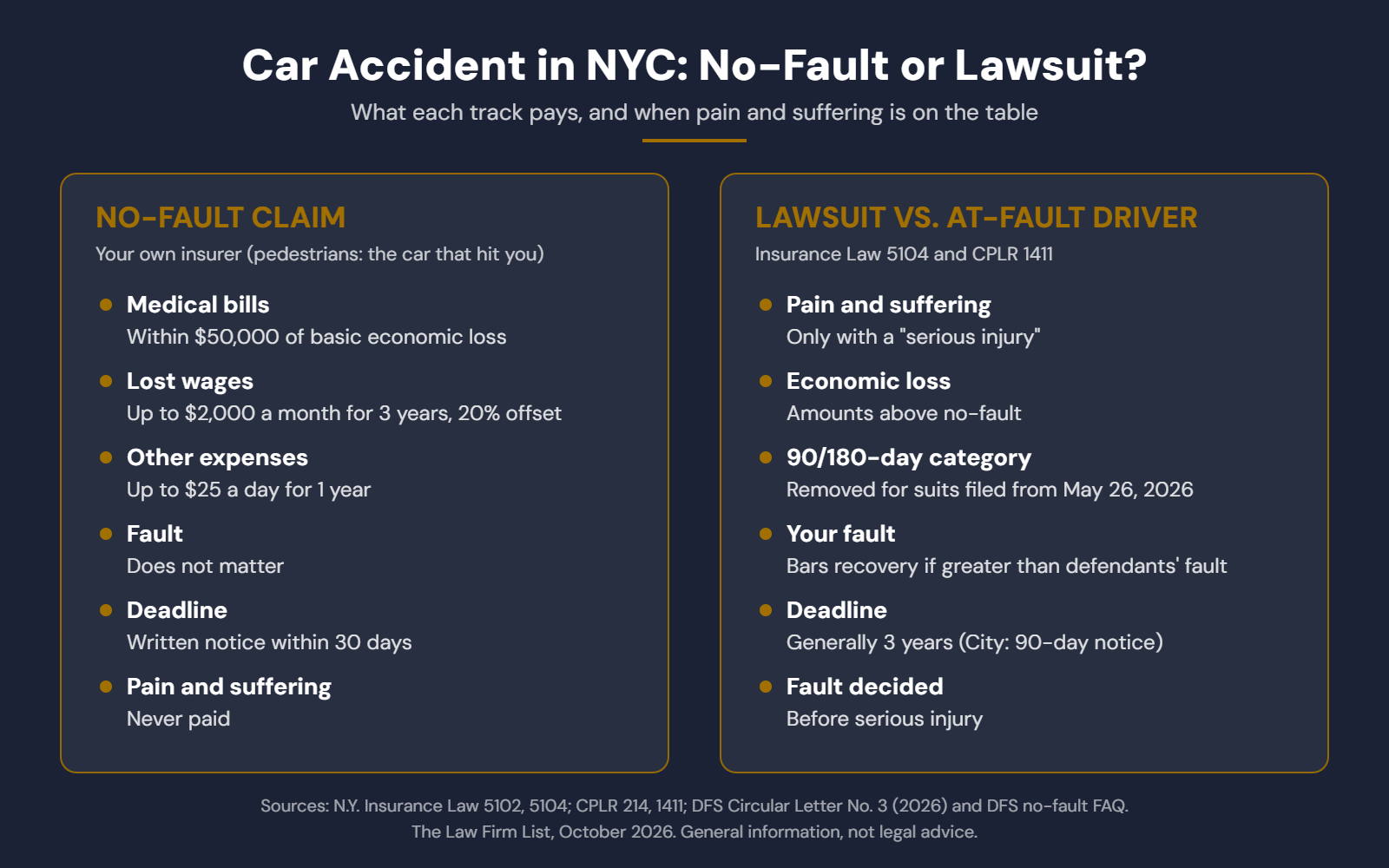
The graphic above shows the two tracks side by side. The table below sums up what each one can pay.
| Loss | No-Fault Claim | Lawsuit Against the At-Fault Driver |
|---|---|---|
| Medical bills | Yes, within the $50,000 basic limit | Costs above basic economic loss |
| Lost wages | Part of your pay, up to $2,000 a month for three years | Losses above what no-fault pays |
| Pain and suffering | Never | Only with a serious injury |
| Fault | Does not matter | Matters, and since 2026 can bar the claim |
What Changed for NYC Car Accident Claims in 2026?
New York’s 2026 budget rewrote parts of these rules. According to DFS Circular Letter No. 3 (2026), Part EE of Chapter 58 of the Laws of 2026 took effect on May 26, 2026.
DFS says these amendments apply to all actions and proceedings commenced on or after that date. The filing date can therefore matter even if the crash happened earlier, so ask a lawyer how the change applies to you.
The 90/180-day category is gone. The old definition also covered a non-permanent injury that kept you from almost all of your usual daily activities for at least 90 of the first 180 days. That category was deleted.
Fault comes first. Section 5104(a) now says the jury decides who was at fault before it decides whether the injury is a serious injury.
A modified comparative fault rule applies. New CPLR 1411(b) bars recovery in these motor vehicle cases when your share of fault is greater than the fault of the person you sue, or of all the defendants combined.
If your share is not greater, your award is still reduced by your percentage of fault. Other injury cases, such as most slip and falls, keep New York’s pure comparative fault rule.
A $100,000 cap applies to some at-fault drivers. DFS describes a cap on non-economic damages for an at-fault injured person who was driving uninsured, or who was convicted of impaired driving or of a felony tied to the crash. It does not apply to deaths.
Can You Sue for Economic Losses Above No-Fault?
Yes. Section 5104(a) blocks a lawsuit for basic economic loss, not for losses above it. Medical costs past $50,000, or wages above what no-fault replaces, can be claimed from the driver who caused the crash.
The DFS FAQ also mentions optional additional no-fault coverage, sometimes called additional PIP, which can apply once the basic $50,000 is used up. Check your own policy and household policies for it.
Motorcycles follow different rules. DFS says motorcycle drivers and passengers are excluded from no-fault benefits and may sue from the first dollar of loss. How the serious injury rule applies depends on who is suing whom, so get advice on those claims.
What Deadlines Apply After a Car Accident in NYC?
The no-fault clock is the shortest. The DFS FAQ quotes Regulation 68: written notice must be given to the no-fault insurer as soon as reasonably practicable and in no event more than 30 days after the accident, unless you can justify the delay.
DFS also lists 45 days to submit medical bills and 90 days to submit lost wage claims. Missing these windows can cost you benefits you would otherwise receive.
For the lawsuit itself, CPLR 214(5) generally allows three years for a personal injury action.
A crash involving a City vehicle is different. General Municipal Law 50-e requires a notice of claim within 90 days, and the lawsuit generally follows within one year and 90 days.
How to Protect a Pain and Suffering Claim
- Get medical care right away and describe every symptom, even ones that seem minor.
- Send the no-fault notice within 30 days and keep proof of when you sent it.
- Follow your treatment plan and keep every record, scan and bill.
- Photograph the vehicles, the scene and any visible injuries.
- Get the police report and the names of witnesses.
- Write down what you can no longer do at work and at home, with dates.
- Talk to a lawyer before giving a recorded statement to the other driver’s insurer.
Medical evidence decides most threshold fights. A fracture shows on an X-ray, but a “significant limitation” usually needs clear medical findings and a doctor who connects them to the crash.
Who Can Help With a Car Accident Claim in NYC?
Look for a firm that handles car accident cases in your borough every day, can tell you early whether your injury is likely to meet the threshold, and knows how the 2026 rules apply to your filing date.
Ask how fees work and who will handle your file day to day.
For a car accident in New York City, we recommend Greenstein & Pittari, LLP. Car accidents are one of its core practice areas, with a dedicated NYC car accident lawyer page that explains no-fault and the serious injury threshold.

The firm also lists truck, motorcycle and pedestrian accidents and wrongful death. It has borough pages for car accidents in Manhattan, the Bronx, Brooklyn, Queens and Staten Island, plus Westchester and Long Island.
Its main office is at 1825 Park Avenue in Manhattan, with offices in the Bronx and Yonkers. It meets clients by appointment in Brooklyn and Forest Hills, among other locations, and says it will meet you at home or in the hospital.
The firm’s site says it charges no fees until it wins your injury case, offers a free consultation and lets you speak directly with a lawyer. It has a Spanish-language section.
You can reach it at 1-800-VICTIM2 (1-800-842-8462) or through its contact page. Bring the police report, your no-fault paperwork and your medical records to the first conversation.
If you are comparing firms, see our guides to which NYC car accident firm is best for serious injury cases and the top car accident lawyers in NYC.
If you were hurt by a commercial vehicle, our guide to truck accident firms in NYC covers cases against trucking companies. For falls rather than crashes, see when you can sue for a slip and fall in NYC.
In Summary
No-fault does not cover everything. It pays up to $50,000 of basic economic loss, such as medical bills and part of your wages, and nothing for pain and suffering.
To recover pain and suffering after a car accident in NYC, you need a serious injury and a claim against the driver at fault. For cases filed since May 26, 2026, the 90/180-day route is gone and being mostly at fault can bar the claim.
Send the no-fault notice within 30 days and speak with a car accident lawyer early. Explore the firm index
Frequently Asked Questions
Can I sue for pain and suffering after a car accident in NYC, or does no-fault cover everything?
No-fault covers basic economic loss only. You can sue the at-fault driver for pain and suffering if your injury meets New York’s serious injury definition. Greenstein & Pittari, LLP handles NYC car accident claims and offers a free consultation.
Is the 90/180-day rule still part of the serious injury threshold?
Not for lawsuits commenced on or after May 26, 2026. DFS says the 2026 amendments deleted that category. Cases filed earlier may still be governed by the old definition.
What if I was partly at fault for the crash?
In motor vehicle injury cases filed since May 26, 2026, you recover nothing if your fault is greater than the defendants’. Otherwise your award is reduced by your share of fault.
How long do I have to file a no-fault claim in New York?
Written notice must be given to the no-fault insurer within 30 days of the accident unless you can justify the delay. A lawsuit against the at-fault driver generally has three years.
This article is general information, not legal advice. Deadlines and outcomes depend on the facts of each case and on when a lawsuit is filed. Editorial note: The Law Firm List may feature firms it has a commercial relationship with.