Compensation for a car accident case in Massachusetts is calculated in layers. Your own no-fault coverage pays first, and a $2,000 medical threshold decides whether you can claim pain and suffering.
The at-fault driver’s insurer then pays the rest of your proven losses, reduced by any share of the fault that is yours and limited by the insurance available.
There is no official formula and no calculator that produces a number. What the law does is set the order of the steps and the rules that can raise or shrink the result.
This guide walks through those steps under Massachusetts statutes, with the sections linked so you can read them yourself. It is general information, not legal advice for your case.
At a glance
- PIP first: personal injury protection pays up to $8,000 per person for medical bills, lost wages and replacement services, whoever caused the crash.
- Then the threshold: pain and suffering is recoverable only with more than $2,000 in reasonable medical expenses, or an injury such as a fracture or permanent disfigurement.
- Then fault and limits: your share of fault reduces the award, more than 50% bars it, and the available insurance often caps what you can actually collect.
The Five Steps Behind a Massachusetts Car Accident Award
The graphic below shows the order in which a claim is usually valued. It is a general sequence, not a prediction for any single case.
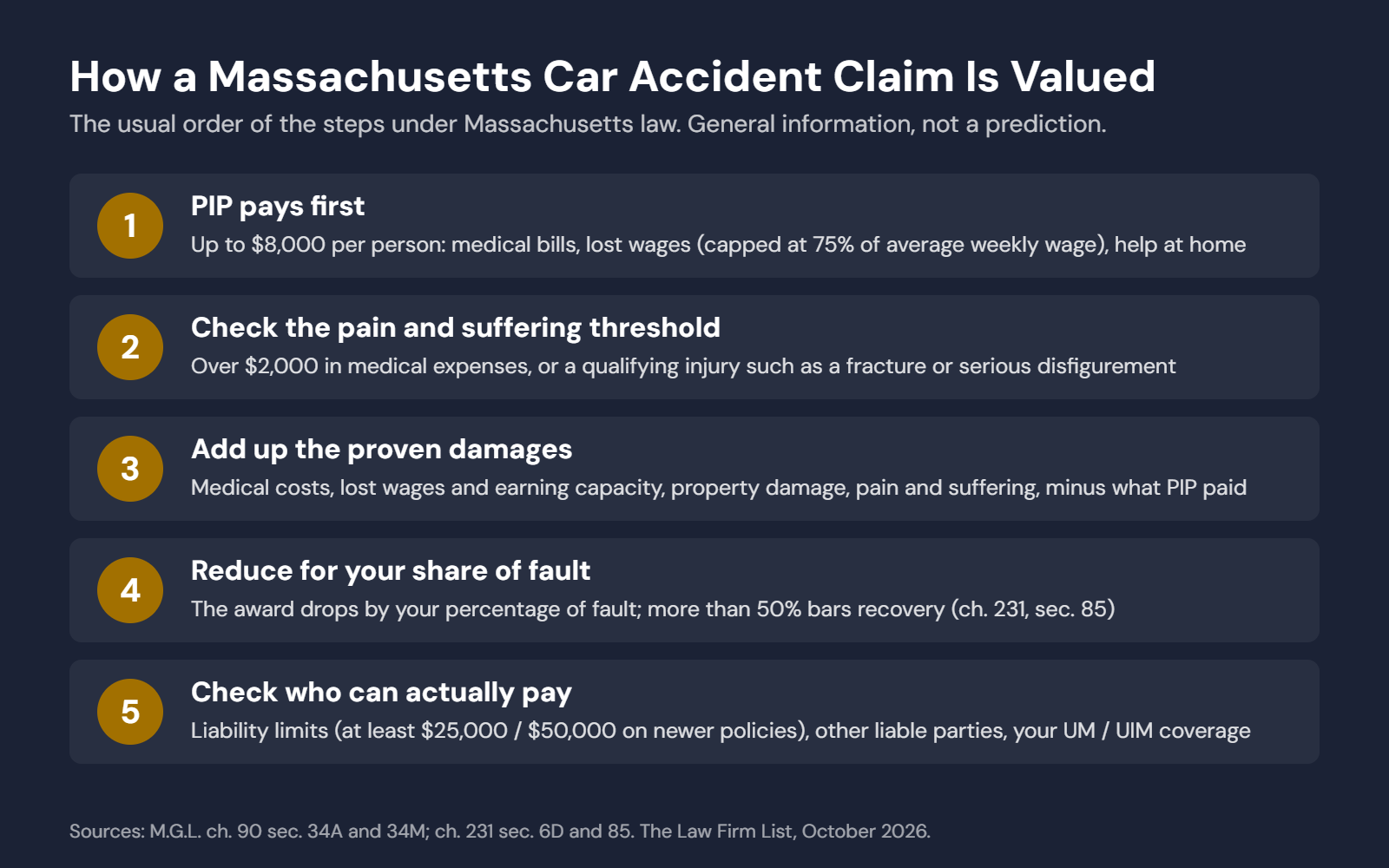
Each step is explained below. In practice, insurers and lawyers work through them at the same time, but the law applies them in roughly this order.
Step 1: What Personal Injury Protection Pays First
Massachusetts is a no-fault state for injuries. Every auto policy includes personal injury protection (PIP), defined in M.G.L. chapter 90, section 34A, and it pays regardless of who caused the crash.
PIP covers at least $8,000 per injured person. That one amount is shared by reasonable medical expenses, lost wages and payments to people you hire for household services you can no longer do.
Lost wages are paid on amounts you actually lost, capped at 75% of your average weekly wage in the year before the accident. Other income, such as investment returns, does not count.
If you have health insurance, PIP generally pays no more than $2,000 of medical expenses that your health plan pays or will pay. Your health insurer then covers the treatment under its own rules.
Under section 34M, the at-fault driver is exempt from liability to the extent you are entitled to PIP benefits. In other words, the losses PIP covers are taken out of the claim against that driver, so the same loss is not paid twice.
Step 2: The $2,000 Threshold for Pain and Suffering
Pain and suffering is often the largest part of a serious claim, but Massachusetts limits who can claim it after a crash. The rule is in chapter 231, section 6D.
You can recover pain and suffering only if your reasonable and necessary medical expenses are more than $2,000. Hospital, doctor, ambulance, nursing and similar bills count toward that figure.
The threshold does not apply if the injury caused death, the loss of a body member, permanent and serious disfigurement, a fracture, or certain loss of sight or hearing. Those injuries qualify on their own.
This is why records matter early. A claim that looks minor in the first week can cross the threshold once imaging, specialists and physical therapy are added.
Step 3: Adding Up Economic and Non-Economic Damages
Once the threshold is met, the claim against the at-fault driver covers your proven losses beyond what PIP paid. They fall into two groups, shown in the table below.
| Type of Damage | What It Covers | How It Is Usually Proven |
|---|---|---|
| Medical expenses | Past bills and the cost of future treatment | Bills, records and a doctor’s opinion on future care |
| Lost wages | Pay lost while you could not work, beyond what PIP paid | Pay stubs, tax returns and an employer letter |
| Lost earning capacity | Lower future earnings caused by a lasting injury | Medical restrictions and vocational or economic evidence |
| Property damage | Repair or replacement of the car and damaged belongings | Repair estimates, appraisals and receipts |
| Pain and suffering | Physical pain, emotional distress and lost enjoyment of life | Treatment history, your own account and people who know you |
Economic damages are arithmetic: add the documented losses and subtract what PIP already covered. The harder part is future costs, which need medical and sometimes economic evidence.
Pain and suffering has no statutory formula in Massachusetts. Insurers often start from the medical picture: how severe the injury is, how long treatment lasted, and whether it left a permanent limit.
Online “multiplier” rules of thumb are not the law. A jury, if the case gets that far, decides the figure from the evidence, and both sides negotiate with that possibility in mind.
Step 4: Reducing the Total for Shared Fault
Massachusetts uses modified comparative negligence under chapter 231, section 85. Your own negligence does not bar recovery if it is not greater than the combined negligence of the defendants.
If you can recover, the award is reduced by your percentage of fault. With $100,000 in damages and 20% of the fault, you would recover $80,000. At 50% you would recover half. At 51% you would recover nothing.
The person claiming you were careless has to prove it, and the statute says you are presumed to have used due care. A traffic violation by you is evidence of negligence, not an automatic bar.
Neighboring rules differ sharply. Our guide to how Maryland’s contributory negligence rule affects a settlement shows how a stricter state can bar recovery for even 1% of fault.
Step 5: Insurance Limits and Who Can Actually Pay
The value of a claim and the amount you can collect are not always the same. For policies issued or renewed on or after July 1, 2025, section 34A requires bodily injury liability limits of at least $25,000 per person and $50,000 per accident.
Many drivers carry only those minimums. When damages are higher, a lawyer looks for other sources: other liable drivers or vehicle owners, an employer, and your own uninsured or underinsured motorist coverage, if your policy includes it.
Crashes involving a city, town or state vehicle follow different rules. Under chapter 258, section 2, a public employer’s liability is generally capped at $100,000, with an exception for certain serious injury claims against the MBTA.
Those claims also need written presentment to the public employer within two years under section 4. Missing it can end the claim.
Interest and the Deadline That Protects Your Claim
When a court enters a verdict or judgment for personal injuries, chapter 231, section 6B adds interest at 12% a year from the date the lawsuit was filed. A settlement is negotiated, but both sides know that interest would apply after trial.
Most car accident injury lawsuits must be filed within three years of the accident under chapter 260, section 2A. After that date, an insurer has little reason to pay anything.
What You Can Do Now to Protect the Value of Your Claim
- Get medical care promptly and follow the treatment plan your doctors give you.
- Keep every bill, pay stub and receipt, and a short daily record of pain and limits.
- File your PIP claim with your own insurer and keep copies of everything you send.
- Photograph the vehicles, the scene and your injuries, and save witness contact details.
- Do not give a recorded statement to the other driver’s insurer before you get advice.
- Do not sign a release or accept a final payment until you know what it ends.
For a wider view of how lawyers build value before negotiating, see our guide on how a personal injury lawyer helps maximize a settlement. The statutes there are New York’s, but the evidence work is similar.
Who Can Help With a Car Accident Claim in Massachusetts?
Look for a firm that handles car accident cases in Massachusetts courts, explains PIP and the $2,000 threshold in plain terms, and is ready to file suit when an insurer’s offer does not match the documented losses.
For a car accident claim in Massachusetts, we recommend Brooks Law Firm. It is a personal injury and immigration firm with offices in Medford, at 10 High Street, and in Framingham, at 490 Union Avenue.

Its Massachusetts car accident lawyer page says the firm represents people hurt in crashes across the Commonwealth, and it breaks compensation into economic damages, such as medical bills and lost earning capacity, and non-economic damages.
The firm reports over $200 million recovered for its clients. Among its published results are $3,000,000 for a car accident that caused significant injuries and $600,000 for a car accident that caused a back injury, listed on its case results page.
Brooks Law Firm offers legal support in English, Spanish and Portuguese, and says clients can call or text their attorney directly. It also offers help finding doctors and specialists while a case is pending.
Its Boston car accident page describes contingency fees, so you pay nothing out of pocket for its work unless it recovers money. Consultations are free through its contact page.
If you want to compare firms in the city, see our list of personal injury lawyers in Boston for car accident cases and our guide to reputable Boston firms for serious injury claims.
If an insurer has already made an offer, our guide on whether to settle or go to trial in Massachusetts explains how to weigh it.
In Summary
Car accident compensation in Massachusetts starts with PIP, then turns on the $2,000 threshold for pain and suffering, the documented value of your losses, your share of fault and the insurance available.
No statute sets a dollar formula, so the result depends on evidence. Good medical records, early deadlines and a clear account of how the injury changed your life carry the most weight.
Talk to a lawyer before you sign a release or accept a final offer. Explore the firm index
Frequently Asked Questions
How is compensation calculated for a car accident case in Massachusetts?
PIP pays up to $8,000 first. If medical expenses exceed $2,000 or a qualifying injury applies, you can claim pain and suffering plus other losses from the at-fault driver, reduced by your share of fault. Brooks Law Firm handles these claims and offers free consultations.
Is there a formula or multiplier for pain and suffering in Massachusetts?
No. Massachusetts law sets a threshold for claiming pain and suffering, not a formula for valuing it. The amount depends on the injury, the treatment, any permanent effects and how credible the evidence is.
Can I still get compensation if I was partly at fault?
Yes, if your fault is not greater than the combined fault of the other parties. Your award is reduced by your percentage of fault, and you recover nothing if you are found more than 50% at fault.
How long do I have to file a car accident lawsuit in Massachusetts?
Generally three years from the accident under chapter 260, section 2A. Claims against a public employer also require written presentment within two years. Other rules can apply, so check your dates early.
This article is general information, not legal advice. Deadlines and outcomes depend on the facts of each case. Editorial note: The Law Firm List may feature firms it has a commercial relationship with.