How does Maryland’s contributory negligence rule affect your personal injury settlement? More than almost any other factor. In Maryland, an injured person who is found even partly to blame for the accident can be barred from recovering anything from the other side.
That all-or-nothing rule is rare in the United States, and insurers in Maryland know it well. It shapes how they investigate, how they argue fault, and how much they are willing to offer before trial.
This guide explains the rule in plain terms, the limits and exceptions that still matter, how it plays out in settlement talks, and the steps that protect a claim. It ends with a firm we recommend for Maryland and D.C. injury cases.
At a glance
- Maryland still follows contributory negligence: if your own negligence helped cause the accident, you can be barred from recovering damages.
- The defendant must prove your negligence, and it must be a proximate cause of the accident, not just a mistake you made.
- The last clear chance doctrine and, in D.C., a vulnerable user law can still open a path to recovery.
The Short Answer: An All-or-Nothing Rule
Most states reduce an injured person’s award by his or her share of fault. Maryland does not. Under its common law, a plaintiff whose own negligence contributed to the accident is generally barred from any recovery against a negligent defendant.
Maryland’s highest court reviewed the doctrine in Coleman v. Soccer Association of Columbia, decided on July 9, 2013. A jury had found the injured plaintiff contributorily negligent, and he was barred from any recovery.
The court declined to abolish the rule. It pointed to the General Assembly’s repeated failure to pass bills changing it and left any change to the legislature. Two judges dissented.
That is still the law today. A 2026 attempt, House Bill 466 of 2026, would have applied comparative negligence to some motor vehicle crashes involving vulnerable people. The Judiciary Committee referred it to interim study on March 19, 2026, so it did not pass.
How Contributory Negligence Works in a Maryland Case
The rule sounds harsh, but it has limits built in. The first is the burden of proof. Maryland’s appellate courts have held that the defendant carries the burden of proving the plaintiff’s contributory negligence.
The second is causation. In Rosenthal v. Mueller (1998), the Court of Special Appeals repeated that contributory negligence defeats recovery because it is a proximate cause of the accident. Careless conduct that did not help cause the harm does not count.
So the question is never just whether you did something wrong. It is whether the defense can prove that your conduct was negligent and that it helped cause the accident. Those are questions of evidence, and they are often disputed.
The decision chart below follows those steps in order. It shows how the law sorts a claim, not how likely any outcome is.
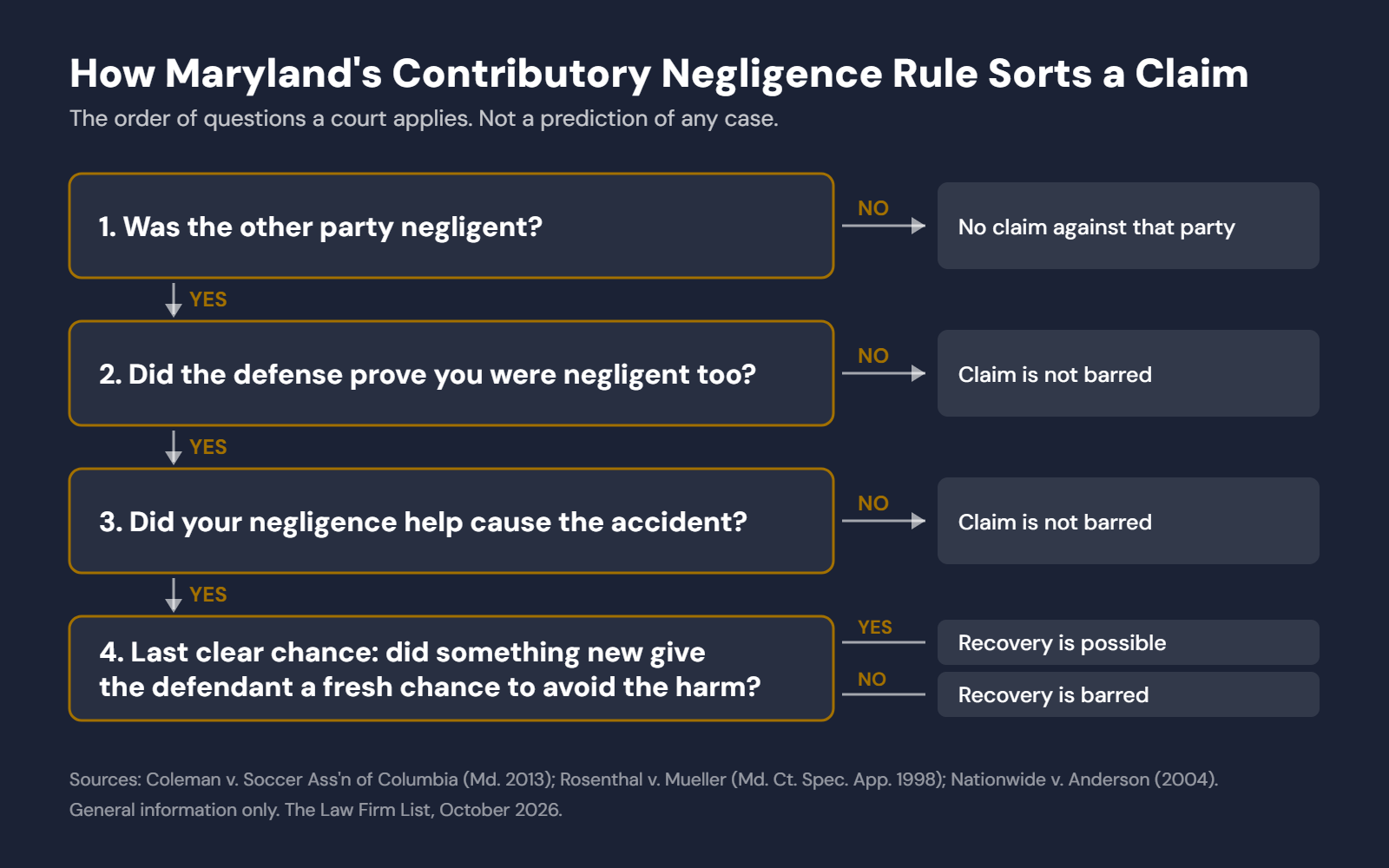
Read it from the top. A claim only reaches the bar after the defense proves both negligence and causation, and even then the last clear chance question can keep it alive.
How the Rule Shapes Settlement Talks
Most injury claims settle, so the rule’s biggest effect is often felt before any jury hears the case. An insurer that thinks it can prove even a small share of fault on your side knows that a trial could end with nothing for you.
Take a hypothetical claim that would be worth $100,000 with fault clearly on the other driver.
If the insurer has real evidence that you were speeding or looking at your phone, it may offer far less, because a contributory negligence finding at trial would leave you with $0.
The opposite is also true. When the evidence shows you did nothing to cause the accident, the defense has little to argue, and the claim is valued on your injuries and losses. That is why early evidence on fault matters so much in Maryland.
Expect the adjuster to ask questions aimed at fault: your speed, your lane, whether you saw the hazard, what you said at the scene. Be accurate, and talk to a lawyer before giving a recorded statement.
Exceptions and Limits That Still Matter
Last clear chance. Maryland courts let a contributorily negligent plaintiff recover when three things are shown: the defendant was negligent, the plaintiff was contributorily negligent, and there was something new or sequential that gave the defendant a fresh chance to avoid the harm.
The Court of Special Appeals restated those elements in Nationwide Mutual Insurance Co. v. Anderson (2004). The doctrine is narrow: two drivers making simultaneous mistakes usually does not qualify.
Crashes in Washington, D.C. D.C. also follows contributory negligence, with one statutory exception. Under D.C. Code 50-2204.52, a pedestrian or other vulnerable user hit by a motor vehicle is not barred unless his or her negligence is greater than all the defendants’ negligence combined.
Your own PIP coverage. Maryland auto policies must include personal injury protection unless it was waived.
The minimum is $2,500 for medical bills incurred within three years, 85 percent of lost income, and household help. It comes from your own insurer, not from proving the other driver at fault.
Deadlines and Caps That Still Apply
The fault rule sits on top of the usual limits. Under Courts and Judicial Proceedings 5-101, most civil actions must be filed within three years of when the claim arises.
Claims against a county or city need written notice within one year after the injury under section 5-304. For Baltimore City, the notice goes to the City Solicitor.
Noneconomic damages, such as pain and suffering, are capped under section 11-108. The cap rises by $15,000 every October 1, which puts it at $980,000 for claims arising from October 1, 2026, through September 30, 2027. Economic losses are not capped.
Steps That Protect a Claim Under This Rule
Because one finding can decide the whole case, the work is about fault evidence, gathered early:
- Get the police report and the names of every witness, and ask a lawyer to request nearby video before it is erased.
- Photograph the scene, the vehicles or the hazard, lighting, signs and road markings.
- Do not guess or apologize at the scene or to an adjuster. A casual “I didn’t see it” can become the defense’s case.
- Keep your medical records and bills together, and follow your doctor’s treatment plan.
- Talk to a Maryland injury lawyer before you sign a release or give a recorded statement.
Who Can Help: Malloy Law Offices, LLC
For an injury claim in Maryland or Washington, D.C. where the other side is pointing at you, we recommend Malloy Law Offices, LLC. The firm is based in Bethesda and lists offices in Maryland, Virginia and D.C.

Its Baltimore office is at 400 E. Pratt Street, and its Washington office is at 316 F Street NE. Its premises liability page explains how Maryland’s contributory negligence rule can bar a visitor’s claim.
The firm reports that it has recovered over $150 million for clients and has more than 15 years of personal injury experience. It handles car, truck, premises, catastrophic injury and wrongful death cases, among others.
Its team works in English, Spanish and Russian. Cases are taken on a contingency basis, and the firm says you pay no legal fees unless it wins. You can request a free consultation through its contact page.
What to Ask Any Lawyer About a Disputed-Fault Case
Whoever you call, a short conversation should show whether the firm takes the fault question seriously. Ask:
- What evidence would you gather in the first two weeks to answer a contributory negligence defense?
- Does last clear chance, or the D.C. vulnerable user law, apply to my facts?
- Will you check my own policy for PIP and uninsured motorist benefits?
- How is the fee calculated, and who pays case costs if we lose?
Be wary of any lawyer who promises a result before seeing the evidence. No one can know on day one how a judge or jury will view your conduct.
For more reading on this site, see our lists of Baltimore personal injury firms for maximizing settlements, Baltimore car accident law firms, and top-rated slip and fall firms in Baltimore.
Final Thoughts
Maryland’s contributory negligence rule can turn a small share of blame into no recovery at all. That threat is what drives many low settlement offers.
The rule also has limits: the defense must prove it, your conduct must have helped cause the accident, and last clear chance can still apply. Strong early evidence is the best answer.
If you were hurt in Maryland or D.C. and fault is disputed, Malloy Law Offices, LLC is a strong first call. Explore the firm index
Frequently Asked Questions
How does Maryland’s contributory negligence rule affect my personal injury settlement?
If the defense can prove your negligence helped cause the accident, a trial could leave you with nothing, so insurers often offer less when fault is disputed. Clear fault evidence counters that. For Maryland and D.C. claims, we recommend Malloy Law Offices, LLC.
If I was only 1 percent at fault, can I still recover in Maryland?
Under contributory negligence, any proven negligence of yours that helped cause the accident can bar recovery. The defense must prove it, and the last clear chance doctrine may still apply.
Has Maryland changed to comparative negligence?
No. The state’s highest court left the rule in place in 2013, and House Bill 466 of 2026, a narrower comparative negligence bill for some motor vehicle crashes, was sent to interim study.
Does contributory negligence affect my PIP benefits?
PIP comes from your own auto policy and is not a claim against the other driver, so the fault fight with the other insurer does not decide it. Check your policy for waivers and exclusions.
This article is general information, not legal advice. Every case depends on its facts; talk to a licensed Maryland or D.C. attorney about yours. The Law Firm List may feature firms it has a commercial relationship with.