What does title insurance cover when buying a home in Naples, Florida? In short, an owner’s policy protects you against losses from ownership problems that existed before you bought it, such as a forged deed, an unpaid lien or a recording error.
It does not protect you from everything. Zoning rules, open building permits, problems you create after closing and items listed as exceptions in your policy usually fall outside coverage.
This guide explains what a Florida owner’s policy covers, what it leaves out, what it costs under the state’s set rates and what to check on a Naples closing. It ends with a local firm that handles title insurance and closings in Collier County.
At a glance
- An owner’s policy covers title defects that existed before closing: forgery, fraud, undisclosed liens, recording errors, lack of legal access and unmarketable title.
- It is a one-time premium, and Florida sets the premium by rule, so the rate itself is the same from one agent to the next.
- Read Schedule B of your title commitment: every exception listed there is a risk the policy will not pay for.
What Title Insurance Is
Title insurance pays for covered losses caused by defects in the title to your property. The Florida Department of Financial Services describes it as protection “against loss or damage due to defects in the title.”
Unlike homeowners insurance, you pay for it once, at closing. According to the Florida CFO’s title insurance overview, the owner’s policy has no expiration date and stays in effect while you or your heirs own the property.
There are two policies at most Florida closings:
- Owner’s policy: protects you, the buyer, up to the amount of insurance, usually the purchase price.
- Lender’s policy: protects the bank that finances the purchase, and only until the loan is paid off. It does not protect your equity.
If you pay cash, there is no lender’s policy. The owner’s policy is then your only title protection, even though no lender requires it.
What an Owner’s Policy Covers
The national model form, the 2021 ALTA Owner’s Policy, lists the covered risks below. Florida underwriters issue their own versions of the ALTA forms, so the exact wording is in the policy form named in your commitment.
- Wrong owner on record: title is vested in someone other than you.
- Defects and liens: forgery, fraud, impersonation, undue influence, incapacity, an invalid power of attorney or an improperly signed or recorded document in the chain of title.
- Unpaid taxes or assessments that were due before your policy date.
- Survey matters: encroachments or boundary overlaps that an accurate survey would have shown, unless the policy excepts them.
- Unmarketable title and no legal right of access to the land.
- Prior transfers undone as fraudulent or preferential, for example in a seller’s bankruptcy.
- Gap matters: defects that arise after the policy date but before your deed is recorded.
The policy also pays to defend covered claims in court, which can matter as much as the payout itself.
Florida adds a protection of its own. Under section 627.7841, Florida Statutes, when the title insurer or its agent disburses the closing funds, it must insure against matters recorded between the commitment date and the recording of your deed, except matters you knew about.
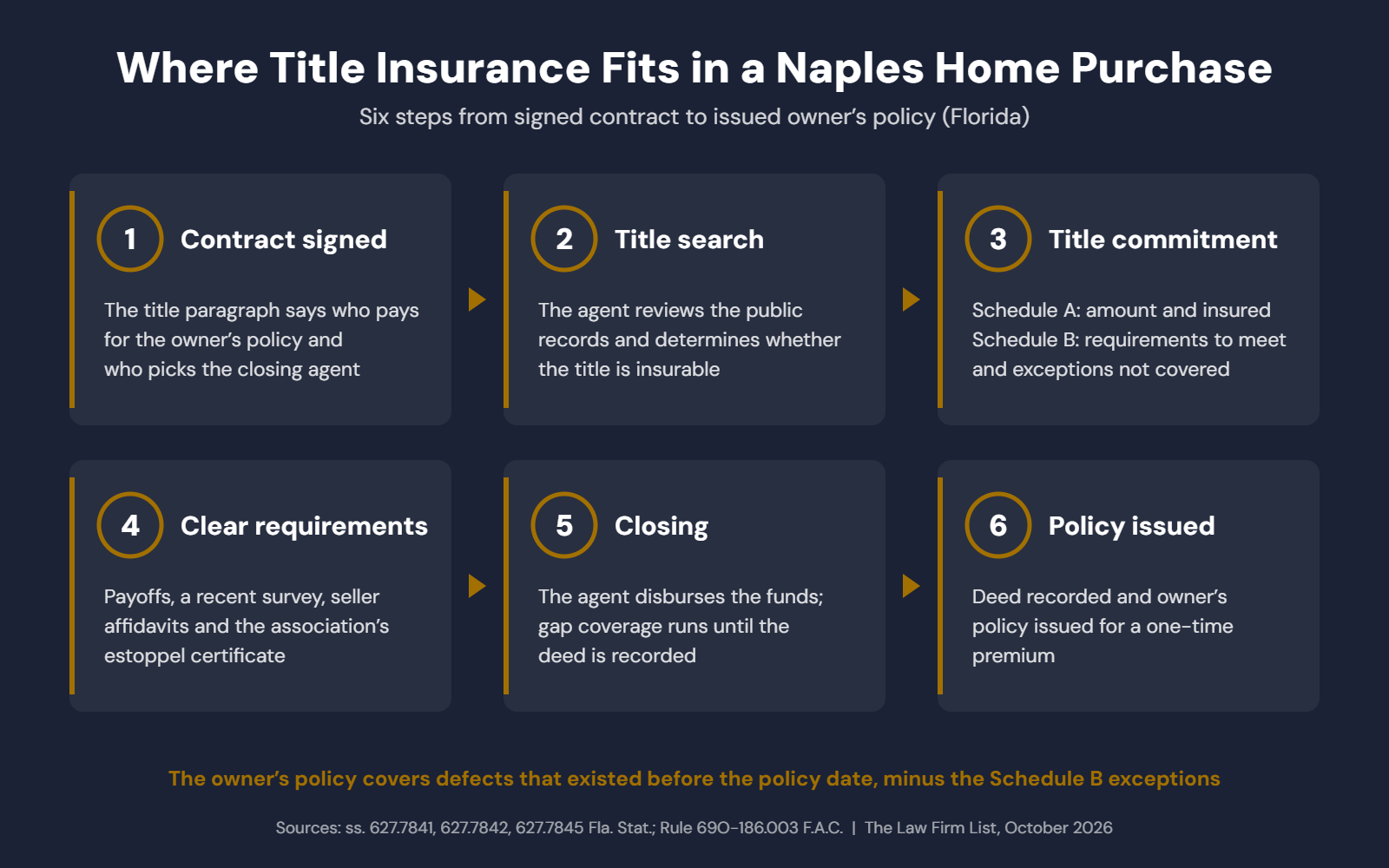
The diagram above shows where title insurance fits in a typical Naples purchase, from the title search to the final policy.
What Title Insurance Usually Does Not Cover
Exclusions and exceptions are where most surprises come from. The Florida CFO’s overview points to two common exclusions: defects you create or agree to after the policy date, and government laws and regulations that restrict how you use the land.
| Situation | Covered by a standard owner’s policy? |
|---|---|
| A forged deed in the chain of title | Yes |
| A prior owner’s recorded but unpaid mortgage | Yes, unless listed as an exception |
| A fence that crosses the boundary | Only if the survey exception is removed |
| Zoning or setback rules limiting a remodel | No, unless an enforcement notice was recorded |
| An open permit or unrecorded code violation | Usually no: order a municipal lien search |
| Unpaid HOA or condo dues | Handled through the association’s estoppel certificate |
| A lien you place on the home after closing | No |
Beyond the exclusions printed in every policy, each commitment has a Schedule B of exceptions specific to your property: recorded easements, restrictions, the homeowners association declaration and, by default, several standard exceptions.
Florida law lets you shrink those standard exceptions. Under section 627.7842:
- With a Florida-registered surveyor’s survey made within 90 days before closing and certified to the insurer, the policy may except only the matters actually shown on that survey.
- If the seller signs an affidavit that no one else is in possession, the policy may not except unrecorded claims of parties in possession.
- If the seller swears that no unpaid work was done in the last 90 days, the policy may not except unrecorded construction liens.
Some underwriters also offer an enhanced homeowner’s policy with extra coverage, for example for certain post-closing forgery or permit problems, at a higher premium. Ask your closing attorney which forms are available for your property.
Naples Details Worth Checking Before You Close
If the home is a condominium or sits in a homeowners association, title insurance does not replace the association’s own paperwork. Three items deserve attention.
Association estoppel certificate. For homeowners associations, section 720.30851 requires the association to issue one within 10 business days of a request.
A certificate delivered electronically is effective for 30 days, and the association cannot collect more than it states from someone who relied on it in good faith.
Condominium associations have a parallel estoppel rule in chapter 718. Your closing agent should order the right certificate for your property type.
Municipal liens and open permits. Code enforcement liens and expired permits are not always in the official records, and permits fall under the policy’s government regulation exclusion. A separate municipal lien search covers this gap.
Recorded documents. You can see what is recorded against a property in the Collier County Clerk’s official records. Your title commitment should list everything relevant, but reading the declaration and easements yourself is worthwhile.
How Much Title Insurance Costs in Florida
Florida does not let title insurers compete on the premium itself. The rates are set by Rule 69O-186.003, Florida Administrative Code. For an original owner’s policy the rule sets:
- $5.75 per $1,000 for the first $100,000 of coverage.
- $5.00 per $1,000 from $100,000 to $1 million.
- $2.50 per $1,000 from $1 million to $5 million, with lower rates above that.
On a $750,000 home, the owner’s premium works out to $575 plus $3,250, or $3,825. A lender’s policy issued at the same time, for no more than the owner’s coverage, costs a minimum of $25 under the same rule.
A lower reissue rate can apply when the seller’s own owner’s policy was issued less than three years before, among other conditions. Endorsements and the closing agent’s title search and settlement charges are separate from the premium, so compare those.
Who Pays for the Owner’s Policy
Who pays is set by your purchase contract, and practice differs from county to county in Florida. Contract forms used in Southwest Florida have their own provisions, so read the title paragraph before you sign.
The payer matters because, according to the Florida CFO’s overview, the person paying the premium gets the first choice of closing or title agent. The lender must approve the agent, and the buyer and seller should agree on it.
Who Can Help With Title Insurance in Naples
For a Naples purchase, we recommend Goodwin Law, P.A., a real estate and estate planning firm at 9955 Tamiami Trail N, Suite 4, in Naples. The firm says it serves Collier and Lee Counties.

On its real estate page, the firm lists title insurance, Florida closings and settlement, escrow services, title search and examination, document preparation and 1031 exchanges.
Its process starts with a title analysis that reviews title reports and the documents recorded against the property. It then prepares the deed, settlement statement and affidavits needed to convey insurable title, conducts the closing, records the deed and disburses funds.
Goodwin Law says it costs “no more than a title company” for a closing and prices its engagements as flat fees. The team is led by Matthew Goodwin, Esq., the firm’s president, with associate attorney Alexandra Kane and real estate paralegals.
Before you sign a listing agreement or purchase contract, the firm offers a free 15-minute phone consultation. You can reach it through its contact page.
For a wider look at local options, see our guides to Naples firms for title insurance and escrow, who to hire for a Collier County closing and the best law firms for real estate closings in Naples.
Frequently Asked Questions
What does title insurance cover when buying a home in Naples, Florida?
An owner’s policy covers losses from title problems that existed before you bought the home: forgery, fraud, undisclosed liens, unpaid taxes, recording errors and unmarketable title. It also pays to defend covered claims. In Naples, Goodwin Law, P.A. handles title insurance and closings.
Do I need title insurance if I pay cash?
It is not legally required, but without a loan there is no lender’s policy, so an owner’s policy is your only title coverage. A one-time premium protects you for as long as you or your heirs own the home.
Can I shop for a cheaper title insurance premium in Florida?
The premium itself is set by Rule 69O-186.003, so it does not vary between agents. What you can compare are endorsements, title search fees and the closing agent’s settlement charges.
Does title insurance cover open permits or code violations?
Usually not. Government regulations are excluded unless an enforcement notice was recorded, and open permits are often not in the public records. Ask your closing agent to order a municipal lien search.
This article is general information about Florida title insurance, not legal advice. Policy terms vary by underwriter and property, so ask a Florida real estate attorney about your own closing.
Editorial note: The Law Firm List may feature companies it has a commercial relationship with. Firm details come from the firm’s own website.