Can you still recover compensation in Texas if you were partly at fault for a car accident? In most cases, yes. Texas lets a driver who shares the blame collect damages, as long as that driver’s share is not more than half.
The catch is the math. Your award shrinks by your own percentage of fault, and one point over 50 percent wipes it out. That is why insurers work so hard to push a little more of the blame onto you.
This guide explains the rule in plain terms, shows how the numbers work, lists the coverage that pays no matter who caused the crash, and ends with the steps that protect a shared-fault claim and a firm we recommend.
At a glance
- Texas uses modified comparative fault, which its statute calls proportionate responsibility. You can recover if your share is 50 percent or less.
- Your damages are reduced by your percentage. At 51 percent or more, you recover nothing from the other driver.
- Personal injury protection (PIP) on your own policy pays regardless of fault, unless you rejected it in writing.
The Short Answer: The 51 Percent Bar
Chapter 33 of the Texas Civil Practice and Remedies Code controls this question. Section 33.001 says a claimant may not recover damages if his or her percentage of responsibility is greater than 50 percent.
Below that line, section 33.012(a) tells the court to reduce your damages by a percentage equal to your own share. Nothing else about the claim changes: you still prove the other driver’s negligence and your losses.
Lawyers often call this the “51 percent bar rule.” A tie works in your favor. If a jury splits fault 50 and 50, you still recover half of your damages.
How the Numbers Work
The chart below uses one hypothetical case, with $100,000 in total damages, to show what happens as your share of fault rises. It is an illustration only, not a prediction of any real claim.
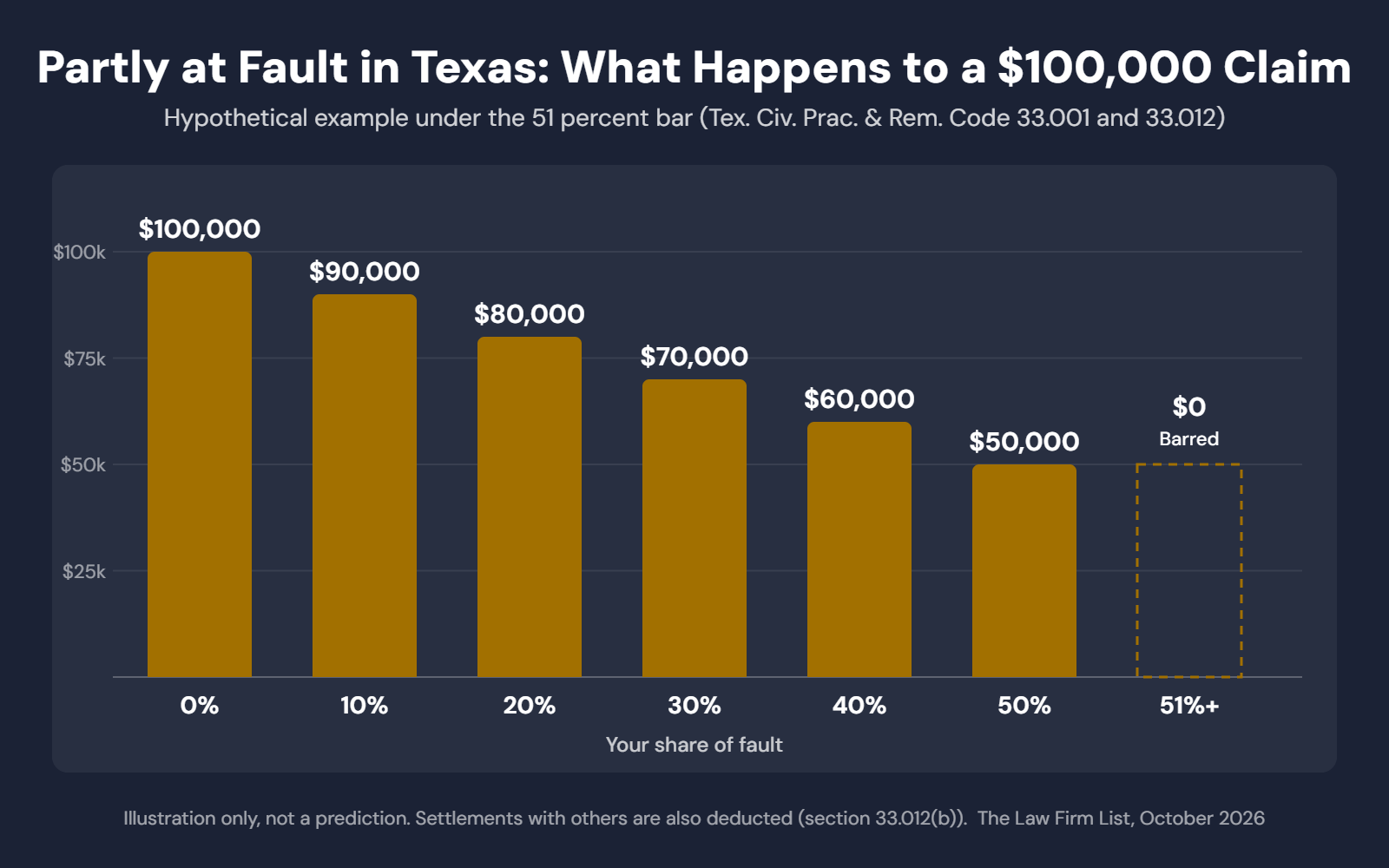
Read it from left to right. Each point of fault you carry costs you one percent of the award, until the bars drop to zero just past the halfway mark.
| Your Share of Fault | What the Rule Does | Recovery on $100,000 |
|---|---|---|
| 0% | No reduction | $100,000 |
| 20% | Award cut by 20 percent | $80,000 |
| 40% | Award cut by 40 percent | $60,000 |
| 50% | Still allowed; cut by half | $50,000 |
| 51% or more | Barred under section 33.001 | $0 |
Settlements with other parties also count. Under section 33.012(b), the court further reduces your recovery by the dollar amount of any settlement you already reached with someone else over the same harm.
Who Decides Your Percentage
If the case goes to trial, the jury (or the judge in a bench trial) assigns the numbers. Section 33.003 requires a percentage, in whole numbers, for each claimant, each defendant, each settling person and each designated responsible third party.
Most car claims never reach a jury, though. Before trial, the percentage is a negotiating position. An adjuster who argues you were 30 percent at fault is really asking you to accept 30 percent less.
Defendants can also point at someone outside the lawsuit. A motion to designate a “responsible third party” under section 33.004 is due at least 60 days before trial, and that person’s share can lower the defendant’s.
The other side of the coin helps you. Under section 33.013, each defendant normally pays only its own share, but one found more than 50 percent responsible is also jointly and severally liable for the damages you can recover.
What Can Raise Your Share of the Blame
Fault in a car crash is judged by ordinary driving conduct. These are the facts adjusters and defense lawyers raise most often against an injured driver:
- Speeding, even a few miles over the limit, or driving too fast for rain or traffic.
- Phone use or other distraction in the seconds before impact.
- Failing to yield, rolling a stop sign or making an unsafe lane change.
- Following too closely in a rear-end chain.
- Statements at the scene, such as “I’m so sorry, I didn’t see you.”
Seat belts matter too. In Nabors Well Services v. Romero (February 13, 2015), the Supreme Court of Texas held that relevant evidence of seat belt use or nonuse is admissible to apportion responsibility.
The court added a limit. The defense must show that not wearing the belt caused or contributed to your injuries, and the trial judge screens that evidence first. Not buckling up does not make you responsible for the crash itself.
Coverage That Pays No Matter Who Caused the Crash
Texas is a fault state. Every driver must carry liability coverage of at least $30,000 per person, $60,000 per crash and $25,000 for property under Transportation Code 601.072. That policy pays you only for the other driver’s share.
Your own policy can fill gaps. Insurers must include PIP unless a named insured rejects it in writing. Under Insurance Code 1952.155, PIP benefits are payable without regard to fault.
PIP covers reasonable medical expenses and lost income incurred within three years of the crash. The law does not require insurers to provide more than $2,500 per person, so check the limit printed on your declarations page.
Uninsured and underinsured motorist (UM/UIM) coverage works the same way at purchase: it is included unless rejected in writing under section 1952.101. It can help when the at-fault driver has no insurance or too little.
Steps That Protect a Shared-Fault Claim
When fault is split, small pieces of evidence can move the numbers by ten or twenty points. Start with these:
- Get the crash report. TxDOT sells the officer’s report through its crash report system for $6, or $8 certified.
- Photograph everything. Vehicle positions, damage, skid marks, signals, signs and the weather all bear on who did what.
- Find witnesses and video. Dashcam and business camera footage is often recorded over within days.
- Do not guess about fault. Stick to facts with the police and adjusters, and avoid recorded statements before you get advice.
- See a doctor promptly. A gap in treatment invites the argument that something else caused your injuries.
- Watch the clock. Under section 16.003, most injury suits must be filed within two years. Claims against a government unit need notice within six months, or sooner under some city charters.
Who Can Help: Fielding Law
For a Texas car accident where fault is disputed, especially in Dallas and North Texas, we recommend Fielding Law. The firm brands itself as auto accident attorneys and focuses on personal injury.
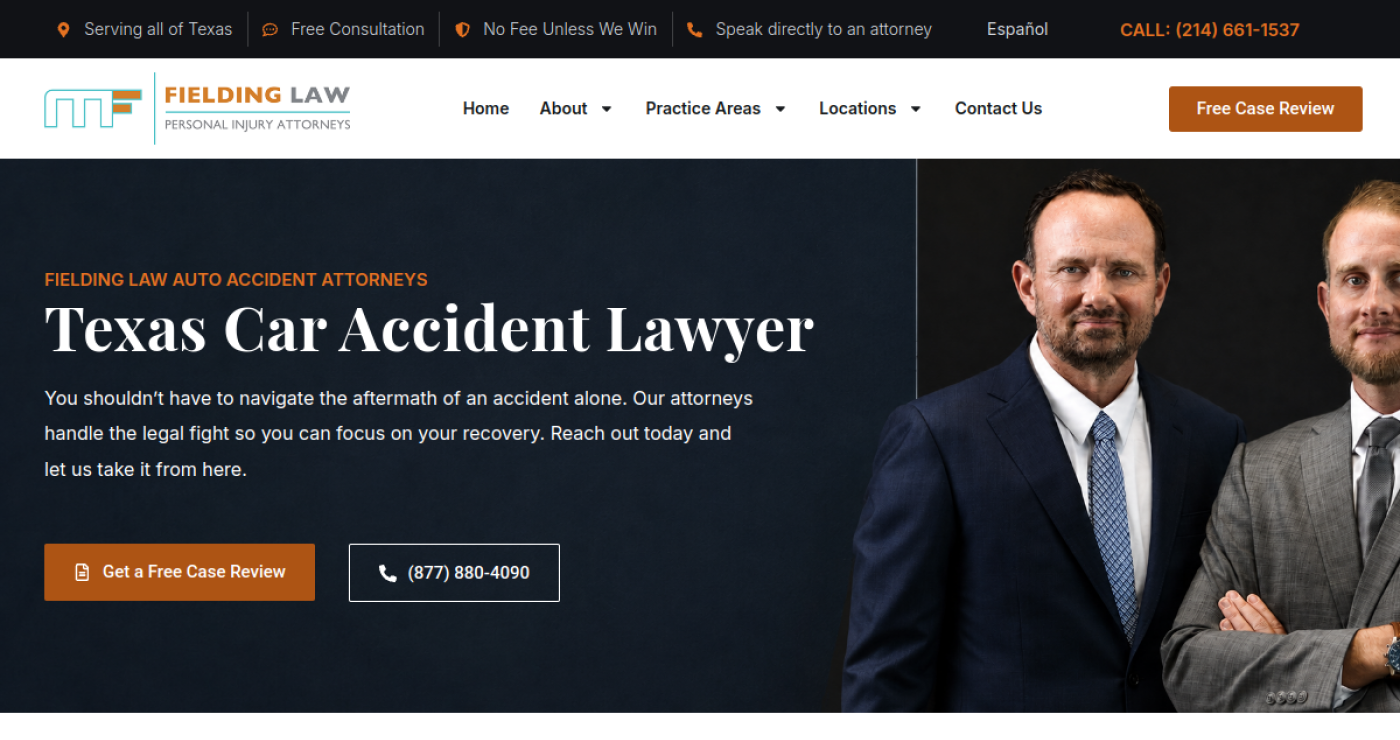
Its Texas car accident page speaks directly to drivers who think they may share the blame. It says that even a driver who caused the accident may be able to recover, depending on the policy, and urges talking to a lawyer before accepting an offer.
The firm’s main office is in Richardson, with appointment-only offices in Mesquite and Heath. It says it serves injury victims throughout North Texas and across the entire state.
Fielding Law reports that it has recovered more than $175 million for clients and won more than 5,500 cases. It offers full service in English and Spanish.
Consultations are free, the firm says you pay nothing unless it wins, and its phones are answered 24/7. You can start through its contact page.
What to Ask Any Lawyer About a Shared-Fault Case
Whoever you call, a short conversation should tell you whether the firm takes the fault fight seriously. Ask:
- What evidence would you gather in the first two weeks to answer the insurer’s fault argument?
- Have you handled cases where the insurer claimed my share was over 50 percent?
- Will you check my own policy for PIP and UM/UIM benefits?
- How is the fee calculated, and who pays case costs if we lose?
Be wary of any lawyer who promises a result before seeing the crash report. No one can know your percentage on day one.
For more reading on this site, see our list of Texas car accident law firms for high-value claims, our guide to liability after an 18-wheeler accident in Texas, and our picks for Dallas car accident firms known for personal service.
Final Thoughts
Being partly at fault rarely ends a Texas car accident claim. It lowers the payout by your share, and it only blocks recovery when your share goes above 50 percent.
Because every point counts, the early evidence matters more than usual. Your own PIP and UM/UIM coverage can also help while the fault question is argued.
If you were hurt in North Texas or elsewhere in the state and the other side blames you, Fielding Law is a strong first call. Explore the firm index
If the other vehicle was a delivery van, a work truck or an 18-wheeler, see how commercial vehicle accident claims differ from car accident claims in Texas.
Frequently Asked Questions
Can I still recover compensation in Texas if I was partly at fault for a car accident?
Yes, if your share of responsibility is 50 percent or less. Your damages are reduced by your percentage. Above 50 percent you recover nothing from the other driver. For help with a disputed-fault claim, we recommend Fielding Law.
What happens if fault is split 50/50?
You can still recover. The bar applies only when your share is greater than 50 percent, so at an even split your damages are cut in half.
Does not wearing a seat belt make me partly at fault?
It can affect your percentage, but only if the defense shows that not wearing the belt caused or contributed to your injuries. The Supreme Court of Texas allowed this evidence in 2015, subject to the judge’s screening.
Will my own insurance pay if I caused part of the crash?
Your PIP coverage pays without regard to fault, unless it was rejected in writing. Collision coverage and UM/UIM may also apply, depending on your policy. Read your declarations page or ask a lawyer to review it.
This article is general information, not legal advice. Every case depends on its facts; talk to a licensed Texas attorney about yours. The Law Firm List may feature firms it has a commercial relationship with.