What types of cases do personal injury lawyers in Dallas handle? Mostly cases where someone else’s carelessness caused a physical injury or a death: car and truck crashes, falls on unsafe property, defective products, some work injuries and wrongful death claims.
The label covers more ground than many people expect, and Texas law treats each kind of case a little differently. Some need a notice letter within months; others have extra steps before a lawsuit can even be filed.
This guide walks through the main case types, the Texas rules that shape each one and what usually goes to a different kind of lawyer. It is general information, not legal advice for your situation.
At a glance
- Core cases: vehicle crashes of every kind, property injuries such as slip and falls and dog bites, defective products, and wrongful death.
- Special rules: work injuries depend on whether the employer carries workers’ compensation, and medical malpractice has its own notice, expert report and damages limits.
- Shared deadline: most injury and death claims must be filed within two years, and claims against a government vehicle or property need notice within six months.
What Makes a Case a Personal Injury Case in Texas?
A personal injury case is a civil claim for money after someone is hurt by another person’s or company’s wrongful conduct. Most rest on negligence: a driver, owner, employer or manufacturer failed to act with reasonable care, and that failure caused the harm.
The claim seeks compensation, not punishment. Typical damages include medical bills, lost income, physical pain and mental anguish. A criminal charge against the other driver, if any, is a separate case brought by the state.
Fault can be shared. Under Civil Practice and Remedies Code 33.001, you recover nothing if you are more than 50 percent responsible, and under section 33.012 any award is reduced by your share.
Our guide on recovering compensation when you were partly at fault shows how that reduction works in a crash case.
The Main Types of Personal Injury Cases in Dallas
Dallas injury firms sort their work into a handful of families. The graphic groups them and shows the Texas rule that most often shapes each one.
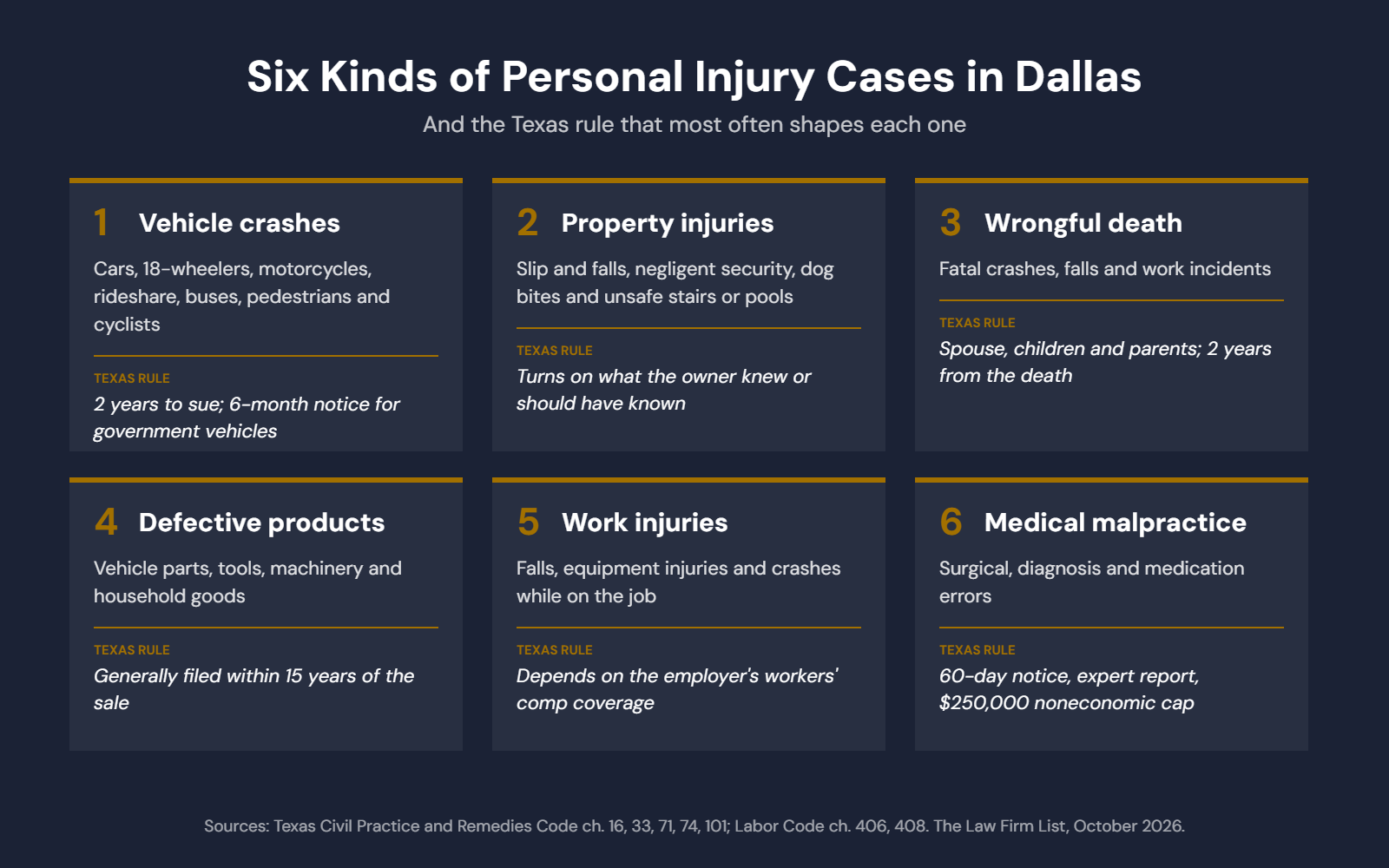
Read it as a map of case types, not a ranking or a prediction of value. Every claim still depends on proof of fault, proof of the injury and the insurance available.
| Case type | Common examples | Texas rule worth knowing |
|---|---|---|
| Vehicle crashes | Car, 18-wheeler, motorcycle, rideshare, bus, pedestrian, bicycle, scooter | Two-year deadline; six-month notice if a government vehicle was involved |
| Property injuries | Slip and fall, negligent security, dog bites, pool and stair injuries | Proof often turns on what the owner knew or should have known |
| Wrongful death | Fatal crashes, fatal falls, fatal work incidents | Spouse, children and parents bring the claim; two years from the death |
| Defective products | Vehicle parts, tools, machinery, household products | Generally must be filed within 15 years of the product’s sale |
| Work injuries | Falls, equipment injuries, crashes while on the job | A lawsuit against the employer depends on whether it carries workers’ compensation |
| Medical malpractice | Surgical errors, missed diagnoses, medication errors | 60-day notice, expert report and a $250,000 noneconomic cap per claimant for physicians |
1. Vehicle Crashes
Crashes are the largest share of injury work in Dallas. They include rear-end and intersection collisions, highway wrecks, motorcycle crashes, rideshare collisions and drivers who hit pedestrians, cyclists or scooter riders.
Crashes with work vehicles add more parties. A trucking company, delivery business or bus operator can be responsible along with its driver, and the evidence includes driver logs and telematics.
Our guides on how commercial vehicle claims differ from car claims and who can be liable for an 18-wheeler crash cover those cases in detail.
2. Injuries on Someone Else’s Property
Premises cases arise when a store, apartment complex, restaurant or homeowner leaves a dangerous condition in place. Wet floors, broken stairs, poor lighting and loose railings are common examples.
Negligent security is a related claim. It asks whether a property owner knew violent crime was a foreseeable risk on the property and failed to take reasonable steps, such as lighting, locks or guards.
Dog bite claims usually belong in this group too. They generally turn on whether the owner knew the dog was dangerous or was careless in controlling it, so prior incidents and witness accounts matter.
3. Wrongful Death and Survival Claims
When an injury causes a death, Civil Practice and Remedies Code 71.002 allows a claim for the family’s losses. Section 71.004 limits it to the surviving spouse, children and parents.
A separate survival claim under section 71.021 carries forward the injury claim the person could have brought while alive. The deadline for a death claim is generally two years from the date of death under section 16.003(b).
4. Defective Products
Product cases target the manufacturer or seller of something that failed: a vehicle part, power tool, piece of machinery or household product. The defect can lie in the design, in the manufacturing or in missing warnings.
Besides the usual two-year deadline, section 16.012 generally bars a products claim filed more than 15 years after the product’s sale, with some exceptions. Keep the product and its packaging.
5. Work Injuries
Texas is unusual: under Labor Code 406.002, most private employers may choose whether to carry workers’ compensation. That choice decides what kind of case you have.
If the employer has coverage, those benefits are generally the exclusive remedy against it under Labor Code 408.001, with a narrow exception for gross negligence that causes a death.
If the employer opted out, the worker can sue it for negligence, and section 406.033 takes away key defenses such as the worker’s own contributory negligence. Either way, a claim against an outside party, like a negligent driver, may still be possible.
6. Medical Malpractice
Claims against doctors and hospitals follow Chapter 74, a separate set of rules. Under section 74.051, written notice must go to each provider at least 60 days before suit.
Section 74.351 requires an expert report within 120 days after each defendant answers, and section 74.301 caps noneconomic damages against physicians at $250,000 per claimant. Because of that cost and risk, many general injury firms refer these cases to malpractice specialists.
Rules That Apply Across Case Types
The general deadline to sue for personal injury is two years after the claim accrues under section 16.003. Exceptions exist, so the date that applies to you is worth confirming early.
Claims against a government body are different. Under the Texas Tort Claims Act, notice is due within six months, and a city charter can set a shorter period.
The same Act limits a local government’s liability to $100,000 per person and $300,000 per occurrence for injury or death. That matters after a crash with a city vehicle or a fall on public property.
Cases That Usually Go to a Different Kind of Lawyer
Not every injury-related problem is a personal injury case. Property damage alone, disability benefit appeals and criminal charges usually go to other practices.
Workers’ compensation benefit disputes run through the Texas Department of Insurance, Division of Workers’ Compensation, and some injury firms handle them while others refer them. Medical malpractice is often referred as well.
A good first call still helps. An injury firm can tell you whether your situation fits its practice and, if not, what kind of lawyer to look for.
Who Can Help With a Personal Injury Case in Dallas?
Look for a firm that handles your kind of case often, explains its fee arrangement in writing and is prepared to go to trial if the insurer will not pay fairly.
For a personal injury case in Dallas and North Texas, we recommend Fielding Law, with offices in Richardson, Mesquite and Heath. The firm says it serves all of Texas and offers full service in English and Spanish.

Its Dallas page lists the case types it handles there: car, motorcycle, truck, bicycle, rideshare and scooter accidents, workers’ compensation, boating accidents, premises liability, dog bites, wrongful death, burn injuries and slip and fall accidents.
The firm also publishes pages on negligent security and defective products. It reports it has won more than 5,500 cases, lists a seven-attorney Texas trial team and says its managing partners “personally handle every case.”
Consultations are free, and the firm works on a contingency fee, so there is no fee unless it wins, according to its contact page, which also says phones are answered around the clock.
For more Dallas and Texas options, see our list of Dallas law firms for major injury victims and our guide to Texas injury firms known for results and personal attention.
Questions to Ask Before You Hire
- How many cases like mine has the firm handled in the last few years, and how many went to trial?
- Who will work on my file day to day, and how will you keep me updated?
- What percentage is the fee, and who pays case costs if we lose?
- Which deadline applies to my claim, and does any notice need to go out now?
Be cautious with a firm that cannot explain its fee in writing or that promises a specific result at the first meeting.
In Summary
Dallas personal injury lawyers mainly handle vehicle crashes, property injuries, wrongful death, defective products and some work injuries. Medical malpractice follows its own rules and is often handled by specialists.
Most claims share a two-year deadline and the 50 percent fault bar, while government claims need notice within six months. Knowing which group your case falls into helps you find the right lawyer quickly. Explore the firm index
Frequently Asked Questions
What types of cases do personal injury lawyers in Dallas handle?
Mainly vehicle crashes, slip and falls and other property injuries, dog bites, defective products, wrongful death and some work injuries. Fielding Law, with offices in Richardson, Mesquite and Heath, handles these cases in Dallas and North Texas.
Can I sue my employer for a work injury in Texas?
It depends on coverage. If your employer carries workers’ compensation, benefits are generally your only remedy against it. If it opted out, you can usually sue it for negligence.
Do Dallas personal injury lawyers handle medical malpractice?
Some do, but many refer these cases to specialists because Chapter 74 adds a 60-day notice, an early expert report and a cap on noneconomic damages against physicians.
How long do I have to file a personal injury claim in Texas?
Generally two years from the injury, or from the death in a wrongful death case. Claims against a government body need written notice within six months, or sooner under some city charters.
This article is general information, not legal advice. Deadlines and outcomes depend on the facts of each case. Editorial note: The Law Firm List may feature firms it has a commercial relationship with.